Why Onions Make You Cry: The Science Explained
By Ellen Brooks · Published · 8 min read
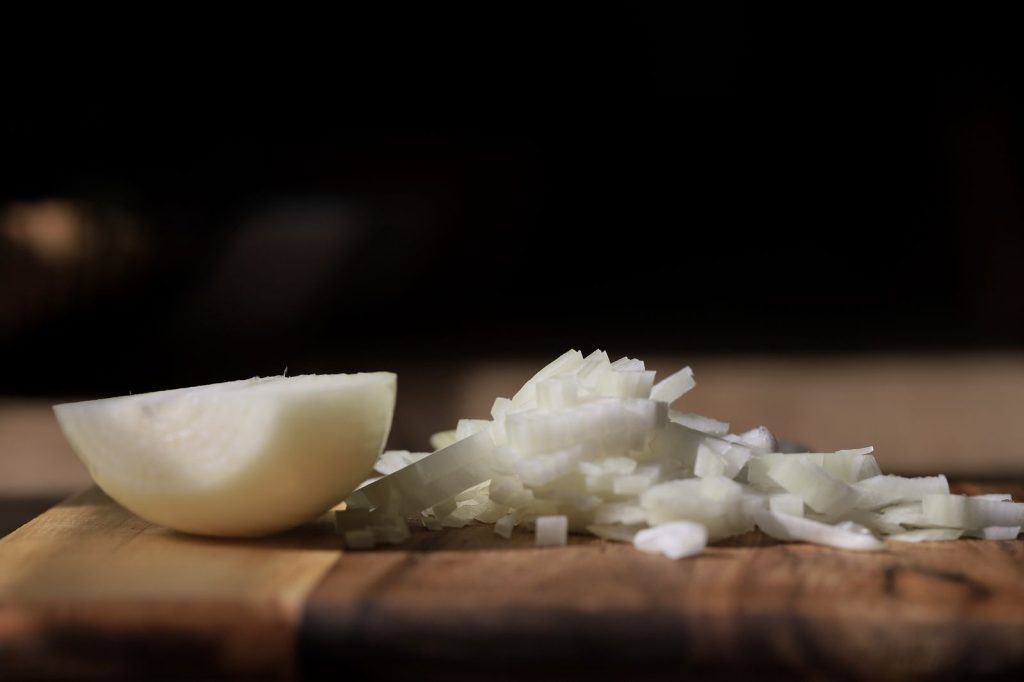
In October 2002, researchers at a food company in Chiba, Japan, reported in the journal Nature that they had found an enzyme nobody knew existed. The paper was titled “An onion enzyme that makes the eyes water.” For years, chemists had believed that the onion’s famous tear-causing compound simply formed on its own after another enzyme did its work. That belief turned out to be missing a step.
More than a decade later, the authors received an Ig Nobel Prize in Chemistry for the work. The prize is given for research that makes people laugh first and think second. The chemistry behind a sliced onion, though, is a precise piece of plant biology, and it explains a lot about how plants defend themselves.
An Onion Is Built From Leaves
It helps to know what is being sliced. An onion plant grows a fan of hollow, flattened, bluish-green leaves, and the bases of those leaves swell to form the bulb. Inside, the bulb is made of compressed underground stems wrapped in fleshy scale leaves around a central bud.
The bulb begins to swell once the days reach a certain length. Onions are biennial, though they are usually harvested in the first season. If left in the ground for a second year, the plant sends up a stem topped with a rounded cluster of white flowers.
Each of those fleshy layers is packed with cells, and every cell carries the same chemical kit. That is why even a thin slice releases the full reaction.
Two Ingredients Kept Apart
An onion is built to stay quiet until something damages it. Inside its cells are sulfur-containing compounds, which are amino acid derivatives called sulfoxides. Elsewhere in the same cells are enzymes called alliinases. As long as the cells are intact, the two stay separate.
Cutting changes everything. When a knife, a tooth or an insect tears the cells open, the enzymes meet their targets, and a rapid series of reactions begins. The onion’s cells effectively set off a chemical alarm. It is a defense mechanism, and the tears are a side effect for anyone nearby.
The Chain Reaction, Step by Step
The sequence is easier to follow when it is broken into stages. Here is the reaction in order:
- Cells are damaged. Cutting breaks the barriers inside the cells and releases alliinase enzymes.
- The enzymes act on the sulfoxides. Alliinase breaks down the amino acid sulfoxides and produces unstable compounds called sulfenic acids.
- A second enzyme steps in. One of these compounds, 1-propenesulfenic acid, is acted on by lachrymatory-factor synthase, usually shortened to LFS.
- A gas forms. The LFS converts the compound into syn-propanethial S-oxide, a volatile gas that drifts through the air.
- The gas reaches the eyes. It stimulates sensory nerves on the surface of the eye, and the tear glands respond.
The very name of the enzyme explains what it does. Lachrymatory comes from the Latin word for a tear, lacrima, and it describes anything that makes the eyes water. That is why chemists call the onion’s gas a lachrymatory factor.
That last step is the visible one. The eye produces tears to dilute and flush away the irritant, which is why the reaction feels like a sudden flood. The gas, not the juice, is the culprit, which is why the effect travels through the air.
The Garlic Puzzle
The 2002 discovery solved a puzzle that had lingered for years. Garlic contains alliinase and plenty of sulfur compounds, yet chopping it does not make anyone cry. If alliinase alone made the tear gas, garlic should do the same job.
Chemists had assumed that after alliinase acted, the compound turned into the tear-causing gas by itself. The Japanese team separated the part of the activity that formed the tear gas from the activity of alliinase. They identified the proteins responsible and tested the gene that encodes them.
The onion’s relatives behave differently. Garlic, scallions, leeks and chives belong to the same plant family, and the English word chive comes from the Latin word for onion, cepa. Species in the family differ in how much of the sulfur chemistry they carry, which is why the group smells alike but does not irritate the eyes in the same way.
To prove the case, they placed that gene into bacteria. The bacteria made a protein that could turn the onion’s natural precursor into the tear-causing compound. The missing step had a name: lachrymatory-factor synthase.
Why Onions Differ
Not every onion hits the eyes equally. The amount of sulfenic acids and tear-causing gas varies among members of the onion family, which botanists call Allium. The root end of a bulb holds a higher concentration of sulfur compounds than the rest, which is one reason the reaction can seem stronger in some cuts than in others.
The color of the bulb gives cooks another set of differences. Yellow onions are sweet and turn dark brown when caramelized, as in French onion soup. Red or purple onions are sharper and are often eaten raw or grilled.
White onions are milder, turning golden when cooked and especially sweet when sautéed. Shallots and potato onions grow in clusters of bulbs, and they belong to a separate group of the same species.
Sweet onions behave differently on the tongue. They contain more water and sugar than ordinary cooking onions, so they taste milder and sweeter, though they do not keep as long. The Vidalia, grown in Georgia, is a familiar example of a sweet variety.
Flavor and tears are connected, too. When the tear-causing step does not happen, the same starting compound can take another path and produce thiosulfinates, which are the compounds behind fresh onion flavor. That fact is what makes the idea of a tearless onion so interesting.
The Tearless Onion
The authors of the 2002 paper suggested that it might be possible to develop an onion that does not cause tears by silencing the gene for LFS. Their reasoning was simple. If the enzyme is removed, the tear gas is not made, and more of the flavor compounds form instead.
Six years later, scientists at the New Zealand Institute for Crop and Food Research reported “no tears” onions made by genetic modification that silenced LFS. The work showed that the idea was workable.
The researchers also suggested that a tearless onion might taste as good as an ordinary one, or even better, because more flavor compound would form. That was a hypothesis, and it had not been fully tried.
A Crop That Is Thousands of Years Old
Nobody knows exactly where onions began. They likely came from Iran, western Pakistan or Central Asia, and domestication probably took place in West or Central Asia. People have grown and bred onions for at least 7,000 years, and the wild ancestor of the cultivated onion is unknown.
Cuneiform recipes from Mesopotamia that use onions and other members of the family date to around 2000 BC. Ancient Egyptians saw the bulb’s round shape and concentric rings as symbols of eternal life, and onion remains were reportedly found in the eye sockets of the pharaoh Ramesses IV.
The Roman writer Pliny the Elder recorded beliefs about onions in the first century AD, and onions appear in Roman recipes attributed to Apicius. European settlers later carried them across the Atlantic, and the Pilgrims reportedly planted them early. The onion’s own history, in other words, is as layered as the bulb.
What the Word Onion Says About Layers
The word onion is recorded in English in the early 1100s, and it came through Old French oignon from the Latin unionem. In Roman speech, that was a country word for a kind of onion, and it also meant “pearl.” It comes from unus, the Latin word for “one.”
The connection to oneness is probably about the onion’s unity of layers. Garlic splits into separate cloves, while an onion stays a single, wrapped whole. A cook who peels one finds layer after layer, all part of the same bulb.
The word kept spawning offspring of its own. Onion-skin paper, a thin, almost translucent sheet, is recorded in 1879, the onion ring in 1904 and the onion dome, the bulbous roof seen on some churches, in 1950. Each borrowed a different feature of the bulb: its thin papery skin, its round layers, its swelling shape.
That image fits the chemistry. Every layer holds the same two ingredients, and each is ready to react the instant a cell is broken.