Classic Hand Tools and the Stories Behind Them
By Ellen Brooks · Published · 7 min read
The first documentation of a screwdriver comes from a medieval manuscript called the Housebook of Wolfegg Castle, written sometime between 1475 and 1490. Screwdrivers were probably invented in the late fifteenth century, in either Germany or France. Early names for the tool were literal: the Germans said Schraubendreher, meaning “screw-turner,” and the French said tournevis, or “turnscrew.”
Most hand tools have a past that stretches back much further than people assume. Some began as stones, others as blacksmith’s tongs, and a few were patented in surprisingly recent decades. Here is a look at where the classic ones came from.
The Hammer: An Ancient Habit
The hammer may be the oldest tool for which definite evidence exists. Researchers working near Lake Turkana in Kenya have found shaped stones about 3.3 million years old, including stones used to strike wood, bone or other stones. Nobody could have called those objects hammers in the modern sense, but the idea of hitting one thing with another is clearly very old.
The first hammers had no handles. By about 30,000 BCE, in the middle Paleolithic, people were fastening stones to sticks with leather strips or animal sinew. The handle gave the user better control and fewer accidents.
A claw hammer, the familiar kind with a curved fork on the back for pulling nails, appears in Albrecht Dürer’s engraving Melencolia I, made around 1514. That is a useful reminder that the shape is centuries old.
The Screwdriver and Its Three Famous Heads
Screws were hard to make before the Industrial Revolution, and the earliest screwdrivers fit the simple slotted heads, with pear-shaped handles. Job and William Wyatt developed a machine that cut the slot and then the thread, which lowered the cost of screws.
Other head designs followed, and three are especially well known:
- Slotted. The oldest and simplest design, with a single straight groove.
- Robertson. P. L. Robertson, a Canadian, was not the first to patent a socket-head screw, but he was the first to sell one successfully, starting in 1908. The square drive is tapered, and Henry Ford reportedly used Robertson screws at his Canadian division because he could not get a license in the United States.
- Phillips. In 1932, in Portland, Oregon, Henry F. Phillips patented the cross-recess screw, working with John P. Thompson. A trial on the 1936 Cadillac was followed by quick adoption across the American auto industry.
Later patterns, such as Torx, were designed for manufacturing efficiency. Their drivers slip less than Phillips or slotted ones.
The Adjustable Wrench and a Monkey
An adjustable wrench has one jaw that slides, so a single tool fits many sizes. The idea has a long history. William Barlow designed a screw-adjusted wrench in 1808, and central-screw designs with a sliding lower jaw were well known by the 1830s.
The Swedish inventor Johan Petter Johansson developed the improved version with a worm screw working along a rack in 1891 and 1892, and he received a Swedish patent in 1892. In the United States, monkey wrenches were the dominant adjustable wrench from the 1860s to the 1910s. The Crescent Tool Company received an American patent for its adjustable wrench in 1915.
The name has a colorful puzzle attached. One historian of tools reports that it originated in Britain from a fancied resemblance between the jaws and a monkey’s face. Later stories tying the name to a particular inventor are folk etymologies and have no good basis.
Pliers: Tongs With a Pivot
Pliers are probably descended from the tongs that blacksmiths used to handle hot metal. Metalworking thousands of years before the common era would have required plier-like devices for holding red-hot material, and the move from wooden tongs to bronze ones likely came very early.
Some of the oldest illustrations of pliers show the Greek god Hephaestus at his forge. No single inventor can be credited, since the idea is ancient and simple.
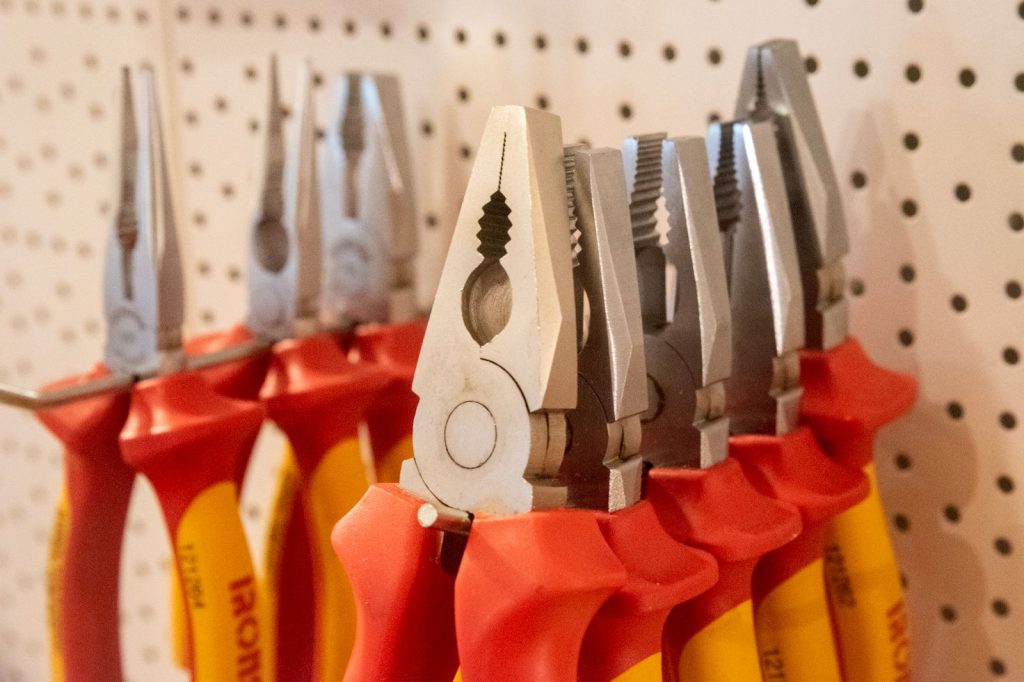
The design has changed little since. A pair still has two handles, a pivot and a head with gripping jaws or cutting edges. What has multiplied is the range of jobs: horseshoes, fasteners, wire, pipes and electronic parts each inspired a version of their own.
The Tape Measure and Its Loose Rivets
Early measuring tapes were cloth, and tailors used unmarked strips notched by hand. James Chesterman is credited with the first retractable tape in 1821, a spring-loaded cloth strip in a compact case. He later patented a steel tape measure, repurposing surplus flat wire from pannier dresses.
William H. Bangs patented a spring-return design in 1864. On July 14, 1868, Alvin J. Fellows improved it with a spring-click mechanism that holds the tape in place.
The modern pocket tape owes a lot to Hiram A. Farrand. His 1922 patent, titled “Rule,” described a curved metal tape that stays rigid when extended, and it became the basis for most modern pocket tapes.
The loose end hook is one of the quietest bits of engineering around. It is attached with loose rivets through oval holes and can slide a distance equal to its own thickness. That small movement gives accurate readings on both inside and outside measurements.
The Level and the Bubble
The spirit level was invented by Melchisédech Thévenot, a French scientist, sometime before February 2, 1661. That date comes from his correspondence with Christiaan Huygens. Within a year, he had shared details of the invention with Robert Hooke in London and Vincenzo Viviani in Florence.
The tool works because the glass vial has a slight upward curve. The bubble rests at the highest point, the marked center. When the level tilts, the bubble drifts away from the center.
The vial is partly filled with a liquid, usually a colored spirit or alcohol. Alcohol is preferred over water because it has low viscosity and surface tension, so the bubble moves quickly and settles accurately. It also stays liquid over a wider temperature range and cannot crack the vial by freezing and expanding.
A colorant such as fluorescein, typically yellow or green, may be added to make the bubble easier to see. Even in the age of lasers, the little bubble in its glass tube is the same idea Thévenot described in the seventeenth century.
Saws and a Chocolate Bar
The earliest saws were not made of metal at all. They were serrated natural materials such as flint, obsidian, sea shells and shark teeth. At Pech-de-l’Azé cave IV in France, serrated tools with signs of wood-cutting have been dated to roughly 90,000 to 30,000 years BCE.
In ancient Egypt, open copper pull saws are documented from the Early Dynastic Period, about 3100 to 2686 BC. Many were found in a tomb dating to the reign of Djer. As Egyptian saws developed, their teeth were raked so they cut only on the pull stroke, and they were later made of bronze and then iron.
The pull stroke has a practical advantage. Pulling takes less blade stiffness than pushing, which allows thinner blades, and that is the principle behind Japanese pull saws. A feature called set, the sideways bending of the teeth, makes the cut slightly wider than the blade so the saw can pass through without binding.
The snap-off blade is a much younger idea. A Japanese manufacturer, OLFA, introduced it in 1956, and it has been called the world’s first. The design was reportedly inspired by the sharp edge of broken glass and by the way a chocolate bar splits into segments, and each segment of the blade can be snapped off when the tip goes dull.
Why Old Designs Barely Change
Looking across these tools, a pattern appears. The pliers of a workshop wall look much like the tongs of an ancient forge, and Dürer’s claw hammer looks familiar to anyone who has seen one in a shop. The slotted screwdriver dates to the late 1400s, and the level’s bubble is older than the United States.
Part of the reason is that a good shape is hard to improve. The tools each solve a single physical problem: striking, turning, gripping, measuring or leveling. When the problem stays the same, the answer tends to stay the same too.
The changes that did come were small and specific, like the cross-shaped recess that helped a driver stay centered on a screw, or the curved tape that stood out straight. Those changes are the reason that the humble tools in a drawer carry so many different dates and so many different inventors.