Station Wagon Road Trips: How Families Hit the Highway
By Diane Porter · Published · 7 min read
By the mid-1960s, some Ford and Mercury station wagons offered four rows of seats and room for ten people. A vehicle like that could carry a large family and its luggage in one piece. That was the point of the American station wagon, and for decades it was the family road trip on wheels.
The vacation itself depended on more than the car. It needed roads, signs, places to sleep and a cultural habit of heading out in the summer. This is how those pieces came together.
From Depot Hack to Family Hauler
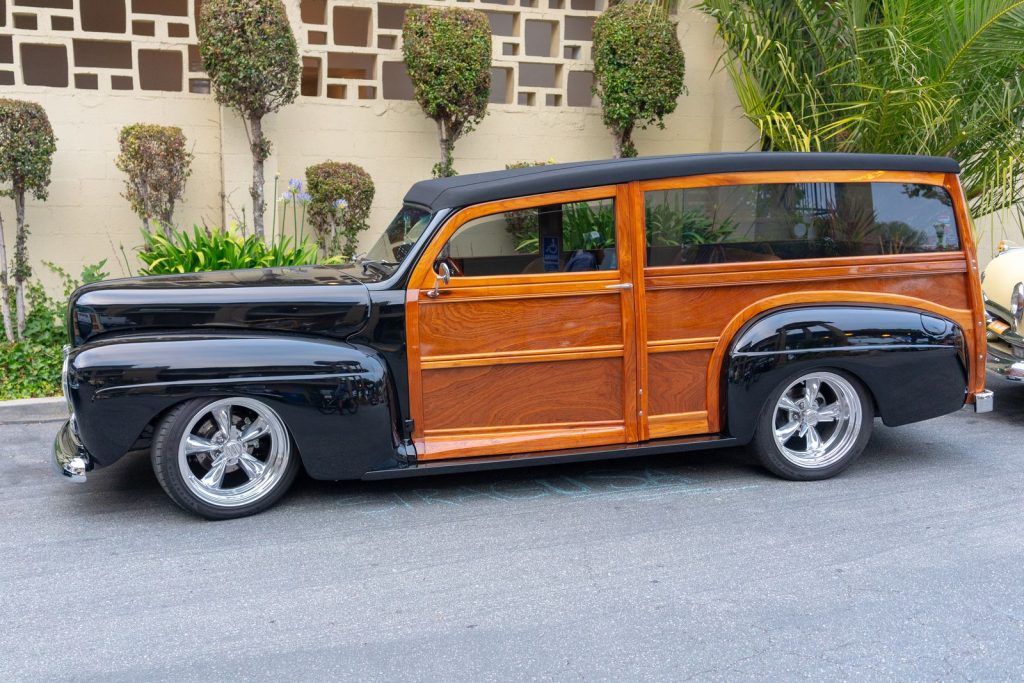
The station wagon began around 1910, when independent makers built wooden bodies on the Model T chassis. These early wagons were called depot hacks, and the ones with exposed wooden bodies became known as woodies. By the 1920s the wagon had been reclassified as a passenger vehicle. In 1923, Star became the first car company to offer one on its production line, and in 1929 Ford became the first of the “Big Three” automakers to sell a factory-built wagon, the Model A.
Steel took over slowly. The 1935 Chevrolet Suburban was the first all-steel wagon, though it was built on a panel truck chassis, and the 1946 Willys Station Wagon was the first mass-produced steel-bodied wagon. By 1951, most wagons had all-steel bodies, and the last wooden-bodied American wagon was the 1953 Buick Super Estate.
Wood did not disappear from the look, however. From 1945 to 1953, steel-bodied wagons carried wooden decorative trim, and by the late 1950s that trim had been replaced by stick-on vinyl simulated wood. Ford’s Country Squire used simulated wood from 1950 to 1991.
Seats Facing Backward
The most famous feature of the big wagon was the way the family sat in it. Chrysler’s 1957 roofline was too low for a forward-facing third-row seat, so the company used a rear-facing one. General Motors used rear-facing third rows in various years from 1959 through 1996. Some wagons offered up to nine seats in total, and Ford and Mercury offered four rows, or ten seats, after 1964.
Designers kept experimenting with how to load and unload the cargo area. The notable examples included:
- Studebaker Wagonaire (1963 to 1966), with a sliding roof section.
- Ford’s Magic Doorgate (1966), a tailgate that folded down or swung open on a side hinge. The 1969 version was the Three-Way Magic Doorgate.
- GM’s clamshell tailgate (1971 to 1976), marketed as the Glide-away tailgate.
- Raised rooflines on the Oldsmobile Vista Cruiser (1964 to 1972), which allowed forward-facing third rows.
When the Wagon Faded
The station wagon had its highest production levels from the 1950s through the 1970s, and the baby boom is linked to that peak. Some of the models had personalities of their own. The 1955 Chevrolet Nomad was a sportier wagon, and the Pontiac Safari arrived the same year.
Then the market shifted. Chrysler minivans eroded the wagon market beginning in 1983, and sport utility vehicles and crossovers later took over the niche. The Chevrolet Caprice and the Buick Roadmaster, the last American full-size wagons, were discontinued in 1996. Smaller wagons from the 1980s onward typically seated five, or six with a bench front seat.
A Road Built for the Trip
The Interstate Highway System was a promise of faster travel. In June 1956, President Eisenhower signed the Federal Aid Highway Act, and the federal government agreed to pay 90 percent of construction costs. Each Interstate had to be a freeway with at least four lanes and no at-grade crossings.
Missouri claims that the first three contracts were signed on August 2, 1956, and that work on U.S. 40 in St. Charles County began on August 13. Kansas claims it was first to start paving, on September 26, 1956.
The original estimate was $25 billion over 12 years. The final system cost well over $100 billion and took more than 35 years, and it was proclaimed complete on October 14, 1992, with the opening of I-70 through Glenwood Canyon in Colorado. The final coast-to-coast section, of I-90, had been finished on September 12, 1991, at Wallace, Idaho. A few toll roads, such as the Kansas Turnpike, were grandfathered into the system.
Drivers learned a new visual language. A 1957 design contest produced the shield, which was designed by a Texas Highway Department employee named Richard Oliver. Its red, white and blue colors match the American flag.
That same year, the numbering scheme set even-numbered routes running east and west and odd-numbered routes running north and south. Odd numbers increase from west to east, and even numbers increase from south to north. The system helped families plan, because a driver could follow one route number across several states without memorizing local road names.
Signs Along the Shoulder
Long before the Interstate, drivers had something to read on the road. The Burma-Vita company of Minneapolis, owned by Clinton Odell, introduced its Burma-Shave brand in 1925, and the roadside signs first appeared on U.S. Highway 65 near Lakeville, Minnesota, in 1926. Typically, six consecutive small signs were posted along the edge of the highway, and the last one was almost always the name of the product.
Hundreds of different sets of signs went up over the years, in most parts of the country. The rhymes were short enough to read at highway speed, and families often read them aloud from the back seat.
The jingles were the point. Each set told a short joke or rhyme, and the product name came last, so drivers read the whole verse before the punchline.
Many of the verses carried safety reminders aimed at drivers. The signs were discontinued in 1963, the same year the company was sold to Philip Morris, and a few surviving sets are preserved in museums and roadside collections.
A Bed for the Night
Staying overnight was a gamble before a motel chain made it predictable. Kemmons Wilson, a Memphis resident, was disappointed by the poor quality of roadside accommodations after a family road trip to Washington, D.C. In August 1952, he opened a place called Holiday Inn Hotel Courts at 4941 Summer Avenue in Memphis. The architect Eddie Bluestein coined the name as a joking reference to the 1942 musical film Holiday Inn. Wallace E. Johnson partnered with Wilson to build more motels on the roads entering Memphis.
The chain grew quickly. Wilson built three more in 1953, and the company reached about 100 locations by 1959 and 1,000 by 1968.
The towering Great Sign out front became the chain’s trademark. It was replaced in 1982 by a cheaper back-lit sign, a change Wilson reportedly called the worst mistake the company ever made.
The Trips That Came First
The family wagon followed earlier road trips that were far more difficult. One of the earliest was a family affair. In August 1888, Bertha Benz drove 106 kilometers (66 miles) from Mannheim to Pforzheim in the third Benz Patent-Motorwagen, with her two teenage sons. The vehicle managed only about 10 miles per hour, and the trip took most of a day.
In 1903, H. Nelson Jackson and Sewall K. Crocker, with a dog named Bud, drove a Winton touring car from San Francisco to New York in 63 days at a cost of $8,000. In June 1909, the Ocean to Ocean Automobile Endurance Contest sent cars from New York City to Seattle, and the first car to arrive took about three weeks. That same year, Alice Huyler Ramsey became the first woman to drive across the country, with three women passengers, and her trip took 59 days. Widely publicized summer trips by Henry Ford, Thomas Edison and Harvey Firestone helped popularize driving to faraway places.
In 1919, a convoy of about 300 Army personnel and 81 vehicles drove from Washington, D.C., to San Francisco in 62 days. Dwight Eisenhower took part, and his report led to a greater focus on cross-country highways. By the 1950s, family car ownership was growing rapidly, and the wagons on the new roads were the descendants of those first long drives.