The Milkman: How Milk Reached the Doorstep
By Diane Porter · Published · 7 min read
Before modern bottles, a milkman went from door to door and filled whatever jug a customer held out, dipping a measure into his churns. The jug belonged to the customer, and the milkman could not know how clean it was. The doorstep routine that older Americans remember grew out of a long effort to change that.
The story runs through a famous scandal, a handful of patents, a laboratory funded by a department store owner and a slow shift in how families shopped. This is how milk delivery was built, and how it faded.
Milk Before the Bottle
In the 1850s, some of the milk sold in New York and Brooklyn came from cows kept in narrow stalls beside distilleries and fed the leftover mash. It was called swill milk. A May 1858 exposé in Frank Leslie’s Illustrated Newspaper described these distillery dairies in Manhattan and Brooklyn.
Milk was also doctored on its way to customers. It was whitened with plaster of Paris, thickened with starch and eggs, colored with molasses and stretched with water and flour. Reformers blamed swill milk for thousands of infant deaths in those years.
A social reformer named Robert Milham Hartley, who had written about city dairies in the 1840s, worked to restore milk’s reputation as a safe drink. Milk regulations passed in 1862 have been described as the first food safety laws.
The Glass Bottle Arrives
The first glass bottle packaging for milk appeared in the 1870s. The New York Dairy Company may have been first, in 1877. A year later, George Henry Lester patented a glass jar meant to hold milk, and a Brooklyn milk dealer named Alex Campbell was credited with selling milk in experimental glass bottles.
The bottles improved over the next few years, and the patents tell the story:
- March 23, 1880: Lewis P. Whiteman is cited for the first patent on a glass milk bottle with a small glass lid and a tin clip, filed on January 31 of that year as U.S. patent 225,900.
- 1884: A Dr. Thatcher, named as Hervey Thatcher in one reference, is credited with a glass milk container in New York.
- September 23, 1884: Abram V. Whiteman, his brother, received a patent for a dome-style tin cap. The brothers made their bottles at the Warren Glass Works in Cumberland, Maryland, and sold them through a New York office.
- April 27, 1886: The “Original Thatcher” patent covered a glass dome lid. Early wooden plugs had failed, and glass stoppers replaced them.
- Around 1900: The Thatcher Manufacturing Company’s Commonsense Milk Bottle is credited with an early cap seat, a feature most later bottles kept.
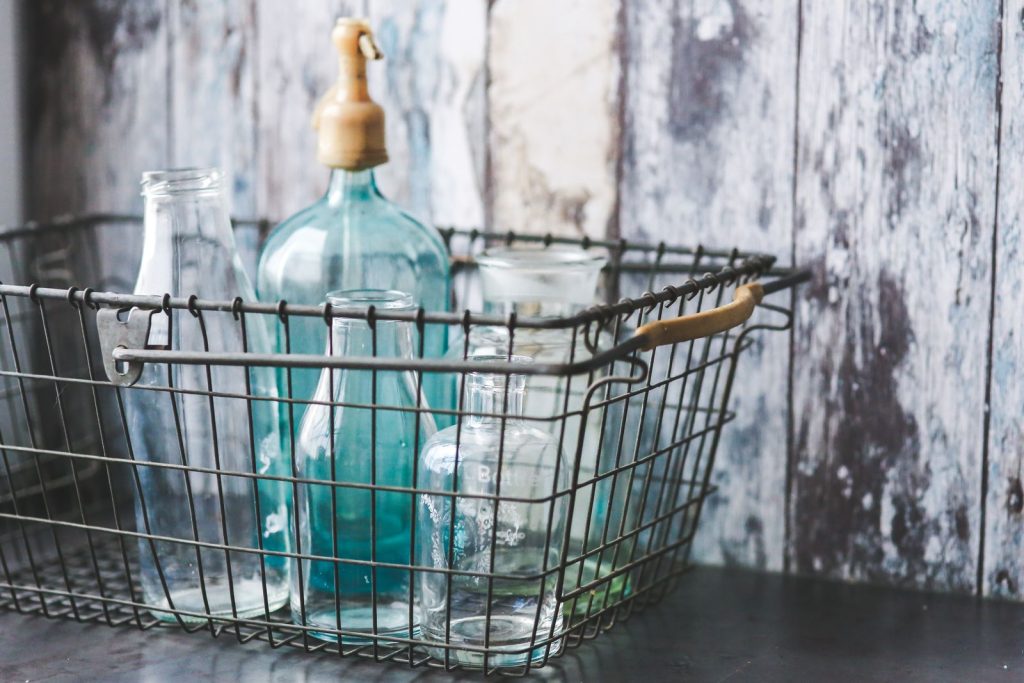
Glass had a big advantage for a milkman. The bottles were reusable and returnable, and customers rinsed the empties and left them on the doorstep for collection. They came in pint and quart sizes, and the same style of bottle was used for doorstep juice. Since the 1930s, many have carried an applied color label, a design printed directly on the glass.
Making Milk Safe
A clean bottle did not solve everything, because the milk inside still had to be treated. The process is named for Louis Pasteur, but his work in the 1860s involved wine, heated to roughly 50 to 60 degrees Celsius. Franz von Soxhlet suggested pasteurizing milk in 1886. The standard conditions are 63 degrees Celsius (145 degrees Fahrenheit) for 30 minutes, or 72 degrees Celsius (162 degrees Fahrenheit) for 15 seconds, and they were set to destroy disease-causing organisms, with tuberculosis among those named.
Nathan Straus, who co-owned the department store R. H. Macy & Company, became a leading advocate. In 1892 he and his wife privately funded the Nathan Straus Pasteurized Milk Laboratory, which provided pasteurized milk to children. In 1910, New York City’s Health Commissioner, Ernst Lederle, introduced mandatory pasteurization of milk there. One reference puts the first state-level mandatory law much later, in 1947.
The science kept developing. In the early 20th century, Milton Rosenau proposed a milk standard of 60 degrees Celsius for 20 minutes, and in 1912 he wrote The Milk Question. Later research refined the heating times and temperatures that are still used.
Why It Came Every Day
A milk route was a daily necessity, and the reason was biology. Raw milk left standing turns sour as bacteria ferment its lactose. Fresh milk left for 12 to 24 hours tends to separate, with a high-fat cream layer collecting on top. That layer is the origin of cream-top, or creamline, milk.
Homogenization later changed the picture. It forces milk at high pressure through small holes and breaks the fat into smaller pieces, so it no longer separates.
Pasteurized milk still has to be kept refrigerated. Milk used to be delivered to households daily in many countries, and improved refrigeration at home is cited as one reason that practice ended.
In some areas, houses had small wooden cabinets built into an exterior wall, with doors on both the outside and the inside. In many places, milk deliverers also carried butter, cream, cheese, eggs, meat and vegetables.
The vehicles changed, too. Horse-drawn wagons did the work for decades, and in parts of the United States motor vehicles replaced them in the middle of the 20th century.
The Kitchen Side of the Door
For almost a century and a half, the icebox was a common household appliance. Later versions had hollow walls lined with tin or zinc and packed with insulation such as cork, sawdust, straw or seaweed. Cheaper models had a drip pan underneath that had to be emptied at least daily.
The electric refrigerator took over slowly. The first ones for home use were invented in 1913, and the first to see widespread use was the General Electric Monitor-Top, introduced in 1927. Freon, a non-toxic, non-flammable synthetic refrigerant, arrived in the 1920s, and separate home freezers followed in the 1940s. Once a family could keep milk cold for days, the daily visit mattered less.
Cartons and Supermarkets Take Over
Plastic-coated paper milk cartons appeared commercially in the 1930s. From the 1960s onward, glass in the United States was almost completely replaced by coated paper cartons or plastic containers, which are lighter, cheaper and safer to make and ship. Supermarkets and household refrigeration made it possible to buy milk whenever it suited the shopper, and to keep it at home for days. In some places the service dropped from daily to three days a week or less before it ended.
Longer shelf lives helped, too. Ultrapasteurized milk is heated to at least 138 degrees Celsius for at least two seconds and lasts 60 to 90 days if refrigerated, while ultra-high-temperature milk in sealed sterile packaging can be stored unrefrigerated for months.
The numbers fell fast, though the sources measure them in different ways. In the early 1960s, roughly three in ten American consumers had milk delivered. By 1975, home delivery was down to about 7 percent of sales, and by 2005 well under 1 percent of consumers had milk delivered.
A Few Routes Never Stopped
The routine did not disappear entirely. Some U.S. dairies have been delivering milk for about 100 years. By 2005, a handful of new companies had sprung up to offer the service, and interest grew as part of the local food movement.
Other countries followed a similar path with their own customs. In New Zealand, people originally paid by leaving money in the empty bottles, and later they used tokens bought at a local shop. Home delivery there faded in the 1990s, after deregulation let supermarkets and other stores sell milk.
Britain used a different vehicle. Electric milk floats served its cities, and for decades Britain had one of the largest fleets of electric vehicles in the world. Doorstep delivery supplied the great majority of British milk in the 1970s, and only a small share of it by the 2010s.
A service that began with a milkman and a customer’s jug lived on, in small pockets, long after the supermarket aisle had become the standard way to buy milk.