
School Days in the 1950s: Readers, Lunches and Drills
By Diane Porter · Published · 7 min read
In 1954, children at Franklin Sherman Elementary School in McLean, Virginia, were among the first to take part in a national polio vaccine trial. The trial eventually involved well over a million children, and the classroom became a public health site. In those same years, schools were also running a new lunch program, teaching reading with Dick and Jane and holding civil defense drills.
The 1950s classroom is remembered mostly through a few vivid images. The facts behind them show a school system that was changing quickly.
The Classroom and the Polio Trial
The United States had outbreaks of 58,000 polio cases in 1952 and 35,000 in 1953, with about 3,200 deaths in 1952. Salk had reported a successful test on CBS radio on March 26, 1953, and the Journal of the American Medical Association published the results two days later. Schools were a natural place to reach children in large numbers. Starting on February 23, 1954, the Salk vaccine was tested at Arsenal Elementary School and the Watson Home for Children in Pittsburgh, Pennsylvania.
The larger trial was led by Thomas Francis. Roughly 440,000 children received one or more injections, roughly 210,000 received a placebo, and about 1.2 million were observed as an unvaccinated control group.
Results were announced on April 12, 1955, the tenth anniversary of President Franklin D. Roosevelt’s death. U.S. polio cases fell from 35,000 in 1953 to 5,600 by 1957 and to 161 by 1961. The March of Dimes promoted the mass immunization campaign.
Learning to Read With Dick and Jane
For many first graders, reading meant Dick and Jane. The series first appeared in 1930 in the Elson-Gray Readers, published by Scott Foresman in Chicago. William S. Gray co-authored the early books, and Zerna Sharp, a former teacher, came up with the idea and created the main characters.
The stories were short and repetitive, with lines such as “See Spot run,” that stayed in the memory of a whole generation. The family had a recognizable cast:
- Dick and Jane, the two main children.
- Sally, their younger sister, along with Mother and Father.
- Spot, who was a cat in the 1930s and a dog in later editions.
- Puff, the family cat.
- Tim, a toy teddy bear.
The books used a whole-word method, also called look-say or sight reading, which leaned on constant repetition of a small vocabulary. Peak popularity came in the 1950s, and by one estimate 80 percent of first graders in the United States were learning to read with these stories.
Critics pushed back. A February 1929 article by Samuel T. Orton had already questioned the method, Rudolf Flesch’s Why Johnny Can’t Read appeared in 1955, and Arther Trace published Reading Without Dick and Jane in 1965. The argument over how reading should be taught lasted for decades.
Lunch Gets a Federal Backer
School lunches were not a 1950s invention. The Starr Center Association began serving penny lunches in Philadelphia in 1894, and the Women’s Educational and Industrial Union began supplying hot lunches to Boston high schools in 1908.
The federal government entered the picture on June 4, 1946, when President Truman signed the National School Lunch Act. The program was set up to prop up food prices by absorbing farm surpluses, and also to feed school-age children. Schools that took part had to follow federal meal guidelines and offer lunches free or at reduced price to children who could not pay. Most of the support came as cash reimbursement for each meal, and schools also received commodity foods, including surplus agricultural stocks when they were available.
Under a 1935 law, customs receipts had already been used to buy farm products and give them to schools. Congress designated National School Lunch Week in 1962.
One Room or Many
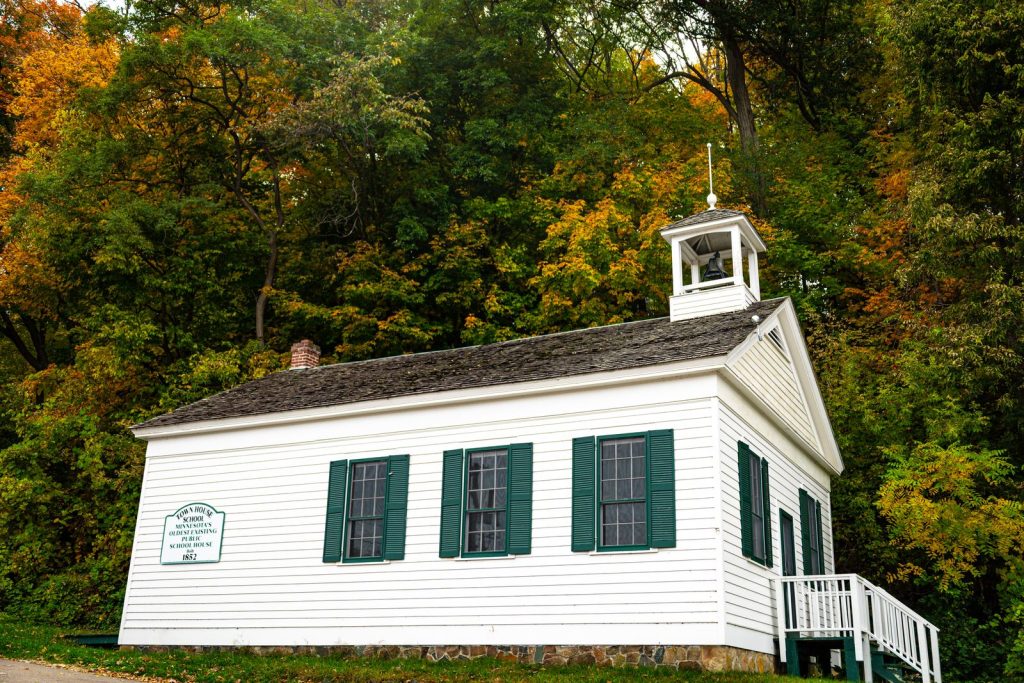
As late as 1930, well over half of the nation’s school buildings were still one-room schools. Consolidation steadily reduced their numbers from the 1920s on, and motorized school buses made it possible across most of the country. By the 1950s they were vanishing quickly, except in the most rural areas.
Hundreds of one-room schools are now listed on the National Register of Historic Places, and a few kept holding classes into the 1950s and beyond. Many communities kept the building long after the last class, and some restored it as a museum, with the old bell back in place.
In a one-room school, a single teacher taught every grade at once, and older students often helped the younger ones with reading and spelling. Teachers in one-room schools were usually daughters of nearby farmers, recent graduates who taught a couple of years before leaving to get married. One account of a typical day describes classes from 9 a.m. to 4 p.m., with two 15-minute recesses and an hour for lunch.
A Landmark Decision
On May 17, 1954, the Supreme Court decided Brown v. Board of Education. Chief Justice Earl Warren wrote the opinion for a unanimous court, and it combined cases from Kansas, South Carolina, Virginia and Delaware, and a companion case from Washington, D.C., was decided the same day. At the time, 17 states required racial segregation in education, and about as many prohibited it.
The court held that separate educational facilities are inherently unequal, which partially overruled the 1896 decision in Plessy v. Ferguson. Thurgood Marshall, the NAACP’s chief counsel, argued for the plaintiffs. A follow-up ruling in 1955 used the phrase “with all deliberate speed.”
The change was not smooth. In September 1957, Arkansas Governor Orval Faubus called out the state National Guard to block nine Black students from entering Little Rock Central High School, and President Eisenhower deployed troops from the 101st Airborne Division.
Duck and Cover
The Soviet Union tested its first nuclear explosive, the RDS-1, in 1949, and many Americans came to see the United States as more vulnerable. In 1950, the adult-oriented booklet Survival Under Atomic Attack listed six survival secrets, including getting shielded, dropping flat and burying your face in your arms.
The Federal Civil Defense Administration produced the child-oriented film Duck and Cover in 1951. It starred an animated character, Bert the Turtle, who pulled into his shell at the first sign of a flash.
Duck-and-cover exercises were presented as part of civil defense drills that Americans, from children to the elderly, were encouraged to practice. Later assessments were skeptical. Historians such as Guy Oakes argued that the exercises served a psychological purpose more than a practical one.
Sputnik and the Science Push
On October 4, 1957, the Soviet Union launched Sputnik, and many Americans feared that education in the USSR was superior. Congress responded with the National Defense Education Act, which President Eisenhower signed on September 2, 1958.
The law emphasized science, mathematics, modern foreign languages and engineering. Funding ran into the hundreds of millions of dollars in its first two years. It also created low-interest federal student loans, which could be partly forgiven for graduates who taught in public schools.
Matching grants helped public schools buy equipment for math, science and foreign language classes, and some funds went to remodeling laboratories. Another section paid for training guidance counselors and for testing programs to identify gifted students.
When the Readers Changed
The reading series evolved, too. In 1965, the Dick and Jane books introduced their first African American family, Mike, Pam and Penny. The series’ final version was published that year, and the readers were sold until 1973, with some classrooms using them through the 1970s.
In the 1980s, other texts replaced them.
The stories that millions of first graders had learned to read faded from the classroom, but the characters had become part of the culture. Collectors still look for the old readers, and reprinted editions have appeared for adults who remember them fondly. The simple pages of “Look, Jane, look” reflected a particular idea about how children learn, and the arguments over that idea have never entirely gone away. The law that followed Sputnik, in the same way, treated classrooms as part of national security.