American Fads: From Flagpole Sitters to Beanie Babies
By Diane Porter · Published · 8 min read
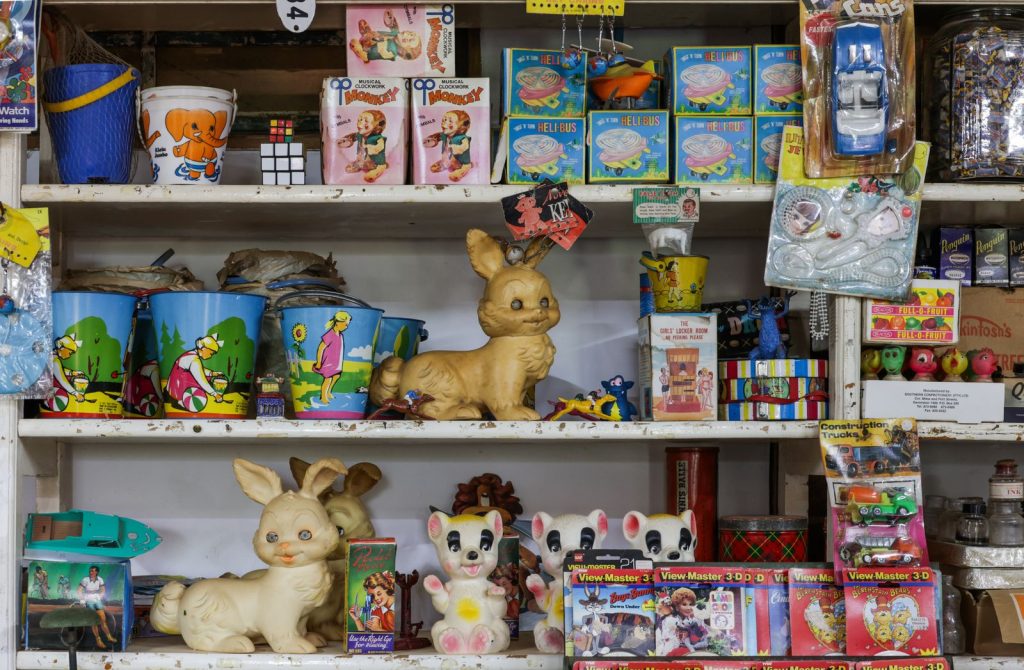
In 1975, a Pet Rock sold for just under $4 and came in a cardboard carrier with air holes and a nest of straw, like a tiny pet crate. By most accounts close to 1.5 million were sold in about six months, and the craze fizzled after Christmas. It remains one of the cleanest examples of a short, bright American fad.
The country has produced many others, from stunts to toys to jewelry. This tour follows the best-documented ones in order, and the numbers show how fast each one rose and fell.
Sitting on a Pole
Alvin “Shipwreck” Kelly is the name most closely tied to flagpole sitting. His first sit, in 1924, lasted 13 hours and 13 minutes. Accounts give his reason as either a dare from a friend or a publicity stunt, and the record does not settle which.
Rivals soon claimed records of 12, 17 and 21 days. The fad was mostly a product of the 1920s, and it faded for the most part when the Great Depression began. Even so, a few sitters kept climbing for decades, and the records kept growing.
- 1924: Kelly’s first sit, 13 hours and 13 minutes
- 1929: Kelly, 49 days in Atlantic City, New Jersey
- 1930: Bill Penfield, 51 days and 20 hours in Strawberry Point, Iowa, until a thunderstorm forced him down
- 1949: Charley Lupica, 117 days, May 31 to September 25, ending on the day of the Cleveland Indians’ final home game
- 1964: Peggy Townsend Clark, reported at 217 days in Gadsden, Alabama
Some sitters made news for other reasons. In 1946, Marshall Jacobs married Yolanda Cosmar on top of a flagpole, and a photo of the couple kissing gained wide attention.
Goldfish on a Bet
College students popularized goldfish swallowing in the late 1930s. The best-known origin story comes from a 1963 letter to The New York Times, which credited a Harvard freshman named Lothrop Withington Jr. with starting it to win a $10 bet tied to a run for class president. That account is a claim, not a proven fact.
Another theory looks back to the 1920s, when Chicago bartenders reportedly passed off pieces of carrot as goldfish. Students fooled by that trick may have inspired the real thing, though no one can say for certain.
The stunt turned into a rivalry among universities, including Penn, MIT and Harvard. In April 1939, Marie Hansen of the University of Missouri School of Journalism was among the first women known to take part. That month, a Los Angeles Times article called the stunt “goldfish gulping” and ran a photo of someone mid-gulp.
Organizations followed quickly. An Intercollegiate Goldfish Gulping Association was set up to determine and enforce competition standards, and a Society for the Prevention of Goldfish Eating appeared in the spring of 1939. A dance called “doing the goldfish” was reported in the Nashua Telegraph.
The record usually cited belongs to Joe Deliberto of Clark University, said to have swallowed 89 goldfish. Critics pushed back, and a Massachusetts state senator, George Krapf, filed a bill to “preserve the fish from cruel and wanton consumption.”
Coonskin Caps
The first three Davy Crockett episodes on Disney’s weekly ABC show aired between December 1954 and February 1955. Crockett’s sudden popularity set off a fad among boys all over the country. Those episodes were edited into the 1955 film Davy Crockett, King of the Wild Frontier.
The cap itself was far older than the television show. Frontier hunters wore fur caps like it, in a style that settlers borrowed from Native peoples, and it was a familiar sight on the frontier long before television. In 1948, Estes Kefauver made the cap a trademark of his campaign for the U.S. Senate, answering a rival’s raccoon-puppet ads with a joke about being a “pet coon.”
The boys’ version of the 1950s was usually a faux fur skull cap with a raccoon tail attached. Girls could buy the Polly Crockett hat, made of all-white fur. At the peak of the fad, caps reportedly sold at a rate of about 5,000 a day.
By the end of 1955, Americans had bought an estimated $300 million worth of Davy Crockett merchandise, including caps and bubble gum cards. The craze spread to Canada, the United Kingdom and Australia. By the end of the 1950s, Crockett’s popularity waned and the fad slowly died out, though Fess Parker, the actor who played him, wore a coonskin cap again in the Daniel Boone series of 1964 to 1970.
The Hoop
Children and adults have played with hoops since ancient times, and the writer Charles Panati records a hoop craze in 14th-century England.
The modern plastic version took a long route. Joan Anderson, who was born in Australia, saw people twirling bamboo hoops there and had the idea carried back to California, where it reached Arthur “Spud” Melin of Wham-O. He and his partner Richard Knerr began making hollow hoops from Marlex, a new plastic from Phillips Petroleum, in 1958.
The name came from the Hawaiian dance, because of the similar hip movements. The toy cost under $2, and the Strong National Museum of Play reports that Wham-O sold 25 million hoops within a few months. Georgia Gibbs’s song “The Hula Hoop Song” added to the publicity in 1958.
Then the market flooded. Wham-O was left with a glut of unwanted hoops, and the toy sat out several years. By one account, Knerr and Melin brought it back in the mid-1960s with ball bearings inside the tube, so it made a swishing sound as it spun.
Rocks and Rings
The Pet Rock came from Gary Dahl, an advertising executive who got the idea in a bar. He reportedly bought the rocks, smooth stones from Mexican beaches, for less than a penny each. He brought in two colleagues, George Coakley and John Heagerty, as investors because he lacked capital.
The rocks were introduced in August 1975 at a San Francisco trade show, and each came with a guide called The Care and Training of Your Pet Rock. Dahl became a millionaire, though the fad was over almost as fast as it began.
Mood rings arrived the same year, and credit for them is shared. The jeweler Marvin Wernick said he got the idea in 1974 from reading about liquid crystals in medical thermometers, while many sources name Joshua Reynolds and Maris Ambats, who were important producers, as the inventors. Sales began in early 1975.
The rings held liquid crystals that changed color with the temperature of the wearer’s finger, shifting from black through green and blue across a narrow range of roughly 90 to 100 degrees Fahrenheit. The color charts were not standardized, though many linked cooler colors to negative emotions and warmer colors to positive ones. Nobody has shown that the colors measured a mood.
By one account, sales reached about $15 million by December 1975, and then demand dropped as the market became oversaturated. After a couple of years, mood rings were out of fashion.
Dolls and Beans
Xavier Roberts was a young art student in north Georgia when he discovered the Doll Babies of craft artist Martha Nelson Thomas. Her dolls came with a birth certificate and adoption papers, and Roberts used the same idea. He opened Babyland General Hospital in Cleveland, Georgia, in an old medical clinic, where employees dressed and pretended to be doctors and nurses caring for the dolls as if they were real.
The “adopted” originals sold for roughly $60 to $1,000. Coleco’s mass-produced Cabbage Patch Kids sold for about $18 to $28 and made their debut at the 1983 International Toy Fair in New York. By the holiday season, shoppers were fighting over them in stores, and Coleco shipped roughly 3 million dolls in 1983. A photo of a Cabbage Patch Kid in the arms of a little girl was the cover of Newsweek in December 1983.
Beanie Babies followed a different formula. Ty Warner introduced them at a 1993 toy fair in New York, and sales began in Chicago-area stores in 1994 at around $5. The first nine characters were:
- Legs the Frog
- Squealer the Pig
- Spot the Dog
- Flash the Dolphin
- Splash the Whale
- Chocolate the Moose
- Patti the Platypus
- Brownie the Bear, later renamed Cubbie
- Pinchers the Lobster
Each had a heart-shaped swing tag, and the four-line poems and birth dates began in early 1996. By 1995, stores could buy only 36 of each character per month, and Warner “retired” characters after a set period. At the height of the craze, Beanie Babies reportedly made up about a tenth of eBay’s sales, and counterfeits turned up in large numbers, with U.S. Customs reporting seizures at Chicago and Orlando airports in 1997 and 1998.
Second Acts
Few fads end cleanly. The Cabbage Patch craze fell hardest: Coleco filed for Chapter 11 bankruptcy protection in 1988, and Hasbro later took over the doll rights. The Pet Rock’s six-month run ended with the 1975 holidays, and the hula hoop spent years on warehouse shelves.
Yet several of them came back. The hoop returned in the mid-1960s with its new sound. Ty announced in December 1999 that it would stop making Beanie Babies, but demand led the company to reconsider, and production restarted in 2000 with a Beanie Baby called The Beginning. The Pet Rock brand has been revived by toy companies more than once since.
The flagpole had the longest second act. H. David Werder sat from November 1982 to January 1984, a total of 439 days. That is more than twice the 217 days reported for the 1964 sit, set long after the fad’s heyday.