Why Leaves Change Color in the Fall
By Ellen Brooks · Published · 7 min read
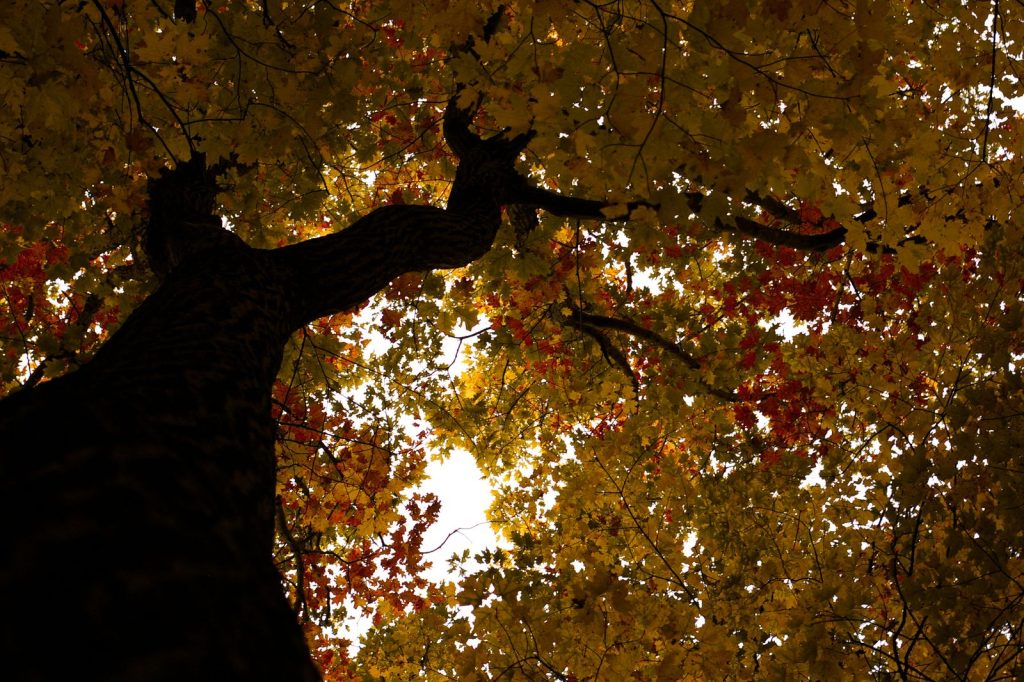
The yellow in a maple leaf in October was already there in June. It was simply covered up. Every leaf carries a mix of pigments all summer, and the one that dominates the mix is green.
Autumn is the season when that balance shifts, and not every color comes from the same process. Some colors are uncovered, one is manufactured on the spot, and a few trees are better at it than others. Here is what happens inside a leaf, and why the show looks different from one place to another.
The Colors Hidden in Summer
Yellow and orange come from carotenoids, a family of pigments that includes xanthophylls and beta-carotene. They are present in the leaf all year. During the growing season, chlorophyll masks them.
As autumn arrives, the chlorophyll breaks down, and the carotenoids show through. The yellow of an October maple leaf is the leaf’s own color, uncovered.
Shorter daylight and cooling temperatures start the process, which is called senescence. Species time the leaf drop that follows differently, which helps explain why one hillside can show several colors at once.
Red Is Made on Purpose
Red and purple are a different story. They come from anthocyanins, which the leaf actively produces in late summer from sugars. Their formation depends on sugar breakdown in bright light, which occurs as phosphate levels drop in the leaf.
Not every tree does this. About 10 percent of tree species in temperate regions produce anthocyanins, and the share rises to as many as 70 percent in northern New England. Vivid colors appear in maples, oaks, sourwood, sweetgum, dogwood, tupelo, cherry and persimmon.
Brown has its own explanation. It can come from green chlorophyll and red anthocyanin mixing during early senescence, or from a chemical change called quinone polymerization late in the process.
Bright, cool days with chilly but non-freezing nights produce the most vivid colors. The reason is that more light means more anthocyanin, so dull days leave less of the pigment behind.
That is why the same woods can look different from one year to the next. The calendar sets the schedule, since shorter days start the process. The weather has a large say in how much red the leaves make.
Why Make Red at All?
The reason trees spend energy on a pigment just before dropping their leaves is still debated. Several ideas have been proposed:
- Sun protection. Anthocyanins may shield leaves from light damage at low temperatures, which could help the tree reabsorb nutrients, especially nitrogen, more efficiently.
- A warning to insects. Red leaves may signal aphids to stay away. An idea published in 2001 holds that this works as a signal, and studies of apple varieties found that more aphids survived on trees without red leaves.
- Other roles. Researchers have also suggested that red helps break up a leaf’s outline for plant-eating animals, that it attracts birds, and that maple anthocyanins may stunt nearby saplings.
None of these has settled the question, and more than one may be true at once.
Two Trees, Two Shows
The quaking aspen is the most widely distributed tree in North America, found from Canada to central Mexico, and it is the state tree of Utah. Its leaves turn golden to yellow and only rarely red. A clone may change color earlier or later than the clones around it, so a hillside of aspens does not turn all at once.
The leaves quake because their stalks are flexible and flattened side to side along their whole length, which makes the leaves twist in the wind. The best-known clone, Pando in Utah, spans 43 hectares, about 106 acres, and weighs about six million kilograms, or roughly 13 million pounds. Most scientists think its seed set sprouted 8,000 to 12,000 years ago, after the last ice age.
The sugar maple offers a wider palette. Its fall foliage ranges from bright yellow through orange to fluorescent red-orange, and some trees show several of these colors at once. Parts of a single tree may change weeks before or after the rest.
It is native to eastern Canada and the eastern United States, and New York, Vermont, West Virginia and Wisconsin have all named it their state tree. A stylized sugar maple leaf appears on the Canadian flag. A sugar maple typically lives about 200 years and occasionally reaches 300, and forty gallons of its sap make one gallon of syrup.
How the Leaf Lets Go
Near the base of each leaf stalk, a layer of cork cells called the abscission layer forms. It gradually cuts off the flow of water and minerals to the leaf. In deciduous plants, the flow of the hormone auxin from the leaf drops, which triggers cell elongation in that layer, so the leaf detaches. A seal forms behind it to prevent loss of sap.
Before the leaf falls, many species move nitrogen and carbon out of it. These are stored as proteins in cells in the roots and inner bark, and the tree reuses them in spring to grow new leaves or flowers.
Dropping leaves has other benefits, too. It reduces water loss during cold winters, when liquid water is less available, and in tropical and dry regions plants drop leaves during dry periods to avoid dying of drought. Leafless trees also suffer less ice-storm breakage and less insect damage.
Evergreens make a different trade. They keep their foliage, so they avoid the cost of regrowing it every spring, but they lose more water in winter and face greater pressure from plant-eating animals.
Why North America Looks Different
North America has more than 800 tree species and about 70 species of oak. Western Europe, leaving out the south, has 51 tree species and 3 oaks. The difference is attributed largely to the Ice Ages.
In North America, many species survived in southern refuges along mountain ranges that run north to south. Much of Europe offered no such refuge, and fewer species survived. A richer mix of trees offers a richer mix of fall colors.
Fall, Autumn and Harvest
Before the 16th century, the usual English word for this season was harvest. As more people moved from farming to towns, harvest came to mean only the act of reaping, and two other words took over as the name of the season.
Autumn comes from the Latin autumnus, possibly from an Etruscan root that suggested the passing of the year. It entered Middle English from Old French, and rare uses appear in the 12th century, though it was in common use by the 16th. Fall comes from Old English and Old Norse words meaning to fall from a height, and it became a season name in 16th-century England. It was likely shortened from phrases such as “fall of the leaf” and “fall of the year.”
English settlers took fall to North America in the 17th century. It became nearly obsolete in Britain but stayed common in America. In Northern England, the word backend was once common for the season, though it has largely been replaced by autumn.
The season’s dates depend on who is counting. In the Northern Hemisphere, meteorological autumn runs from September 1 to November 30, while astronomical autumn runs from the September equinox, around September 22, to the winter solstice, around December 21. The old Celtic reckoning places it from August 1 to October 31.
A Hobby With a Date
Traveling to view fall color has its own name. The Oxford English Dictionary records the first appearance of leaf peeping in 1966, in the Bennington Banner newspaper. The term comes from the United States.
New England and New York are the best-known areas, and Vermont is described as the fall foliage capital of the country. Colorado, Oregon, California and Washington are other popular places.
As of 2007, 25 state tourism offices in the United States promoted leaf peeping. The American foliage season runs from September to early November, while Japan’s typically runs from late October to early December. In Scotland, the colors peak in late October and early November.
The hobby has had to adapt to its audience. In 2024, the Virginia Department of Conservation and Recreation introduced viewfinders at state parks for visitors who are red-green colorblind.