
The Real Origins of the Hot Dog and the Hamburger
By Ellen Brooks · Published · 7 min read
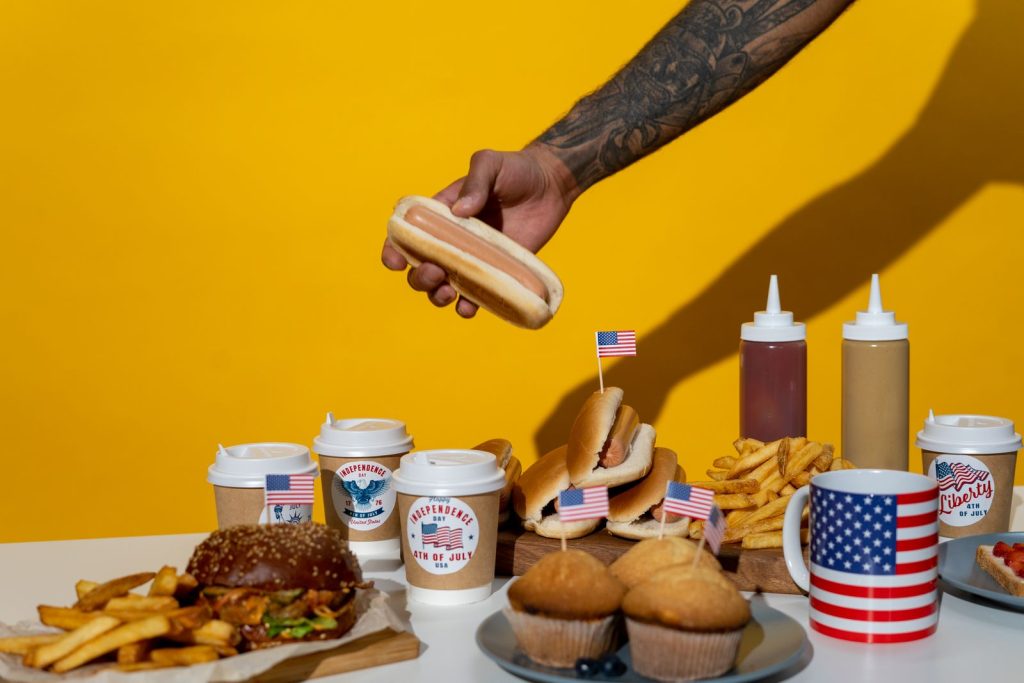
Dictionaries trace the words “hot dog” for a sausage back to the 1880s, with a hint of an even earlier use in 1872. The cartoonist Tad Dorgan, who is so often credited with coining the name around 1900, has no documented use of it before 1906. A story that most people know turns out to be about two decades too late.
That is typical for the two most famous American sandwiches. Both have a German-sounding name, both have a tidy origin story, and both stories fall apart when the dates are lined up. What follows is the record as the sources give it, with the disputes left in.
The Sausage Came First
The hot dog’s main ingredient crossed the Atlantic long before the sandwich existed. Pork sausages called Frankfurter Würstchen are said to have been known in Frankfurt, Germany, since the 13th century, and they were reportedly handed out at imperial coronations, beginning with that of Maximilian II. The word wiener simply means “from Vienna,” the home of a pork-and-beef sausage.
One story credits Johann Georg Lahner, a butcher from Coburg, with bringing the Frankfurter to Vienna, adding beef, and keeping the Frankfurt name. The story is repeated widely, but it is described as something Lahner is “said” to have done, and the dates around him are loose. The safest statement is that the sausage came from German-speaking Europe and that both city names stuck to it.
The Bun Is the Mystery
Putting a sausage in a bread roll is the American step, and nobody can say for certain who took it. These are the usual candidates, with the status of each claim.
- Charles Feltman, Coney Island, 1867: he built a cart for boiling sausages and keeping buns fresh. In 1871 he leased land for a permanent restaurant. The cart is a recorded fact, while the claim that he invented the sandwich is a separate matter.
- Anton Feuchtwanger, St. Louis, about 1880: a German immigrant who is said to have served sausages in buns after customers kept the gloves he gave them. The source for that date needs better support, and other versions of the tale place it at the 1893 Chicago fair or the 1904 St. Louis fair.
- Harry M. Stevens, New York Polo Grounds, 1901: he claimed that he used small rolls when his waxed paper ran out.
No one claim has been confirmed. Several of them may be true at once, because a sausage in a roll is an easy idea for a vendor to arrive at independently. The glove story and the waxed-paper story are both about running out of something, which is the sort of detail that makes a story easy to repeat.
A Name With a Long Paper Trail
The words “hot dog” were in print earlier than most people think. One reference gives 1884 as the earliest cited use for the sausage. Another dictionary says the sense is attested by 1886 and implied by 1872, so the sources do not agree on a single date.
A newspaper item from 1892 is often cited for the term applied to a sausage placed in a gash in a roll, and similar uses are reported in other papers in 1893. The phrase hot dog sandwich is recorded in 1901, and the plainer sausage sandwich is called the earlier term, though the entry gives no date for it. A college word list from 1900 includes “a hot sausage,” which suggests that students were already talking about the food in their own slang.
The Dorgan legend runs into the dates. His earliest documented use of the term is from 1906, and the idea that he coined it around 1900 is described as impossible. A cartoon may have helped spread the word, but the word was already there.
Nathan’s Nickel
Nathan’s Famous began in 1916 as a nickel hot dog stand on Coney Island, at the corner of Surf and Stillwell Avenues. Nathan Handwerker, who lived from 1892 to 1974, arrived in New York in 1912 and started the stand with his wife Ida. The couple reportedly used $300 in savings, and Ida is credited with the recipe.
Handwerker soon worked at Feltman’s German Gardens, according to the account consulted, and later undercut it by charging five cents for a hot dog against Feltman’s ten. That price detail rests on a 1974 news article. A story that two singing waiters encouraged him to compete comes from only one account, and the company’s own history leaves it out.
He is also credited with the term “kosher style” for his all-beef hot dogs, which were not kosher-supervised though they contained no pork.
From Hamburg Steak to Hamburger
The hamburger’s name points to Hamburg, Germany, though the sources call the link contentious. The word hamburger meant a native of Hamburg in the 1610s. The meat product hamburg steak is recorded by 1880. Hamburg was a major departure port for German emigrants, which may be relevant, but the link has never been firmly established.
Several older clues are sometimes offered as the missing link. Hannah Glasse’s cookbook of 1758 included a recipe for Hamburgh sausage, and an 1869 guide documents a Hamburg snack called Rundstück warm, though it may have contained roasted beefsteak and not a meat patty. A story about passengers on the Hamburg America Line, which began service in 1847, is possible but unconfirmed.
Some early evidence is shaky. A Delmonico’s menu from 1834 is often cited as the first American listing for hamburgers, but the printer was not in business yet in 1834, so the date is doubtful. Firmer entries come later: a restaurant in San Fernando, California, listed “Hamburg Beefsteak” between 1871 and 1884, and a Boston newspaper mentioned hamburg steak in 1884. A menu in Walla Walla, Washington, listed hamburger steak in 1889.
The sandwich itself shows up in print on July 5, 1896, when the Chicago Daily Tribune described a hamburger sandwich sold from a “Sandwich Car.” Hamburger sandwich is recorded in 1902, and the shortened hamburger for a bun with a grilled patty is dated to 1909.
Five Claimants, No Winner
Hamburger history is crowded with people who say they were first. The list below gives each claim and its weak point.
- Charlie Nagreen, Seymour, Wisconsin, 1885: he sold meatballs between bread at the Seymour Fair. The local historical society credits him, but the support is mostly local.
- Frank and Charles Menches, 1885: they claimed a beef sandwich at a county fair in Hamburg, New York. Frank Menches’s obituary in the New York Times places the event at a fair in Akron, Ohio, in 1892.
- Louis Lassen, New Haven, Connecticut, about 1900: he grilled a patty between toast. His restaurant, Louis’ Lunch, calls itself the birthplace of the hamburger sandwich. A food critic argues that toasted bread rules it out as a true hamburger.
- Fletcher Davis, Athens, Texas, 1880s: the claim rests on oral histories and a 1904 photograph of “Old Dave’s Hamburger Stand.”
- Oscar Weber Bilby, Tulsa, Oklahoma, July 4, 1891: his family says he served the first hamburger on a yeast bun. A 1995 governor’s proclamation supported the claim, but the sourcing is thin.
The Library of Congress’s Local Legacies project repeated the Louis’ Lunch story, which records a claim and does not settle one. The most honest reading is that several cooks may have invented the sandwich independently.
The Fair, the Castle and the Clipped Name
The hamburger was winning national attention by the 1904 World’s Fair in St. Louis, where the New York Tribune called it the innovation of a food vendor on the Pike. The sandwich spread through small, short-lived vendors, and a single inventor may never have existed.
The same fair appears in the hot dog story, since one version of the bun tale is placed in St. Louis in 1904. The sources consulted describe only the hamburger as gaining its national recognition there.
The next step was standardization. White Castle opened in 1921 in Wichita, Kansas, selling small square patties, and the chain became known for punching five holes in each one so it would cook evenly. Richard and Maurice McDonald opened a restaurant in San Bernardino, California, in 1940 and introduced their Speedee Service System in 1948, and franchising began in 1953.
Meanwhile, the name shrank. Cheeseburger is recorded in 1938 and burger in 1939, and beefburger followed in 1940. The Hamburg in the word became a hidden fossil, because the -burger ending came to mean a patty in a bun, with no link to any city.