The Bald Eagle’s Comeback Story
By Ellen Brooks · Published · 7 min read
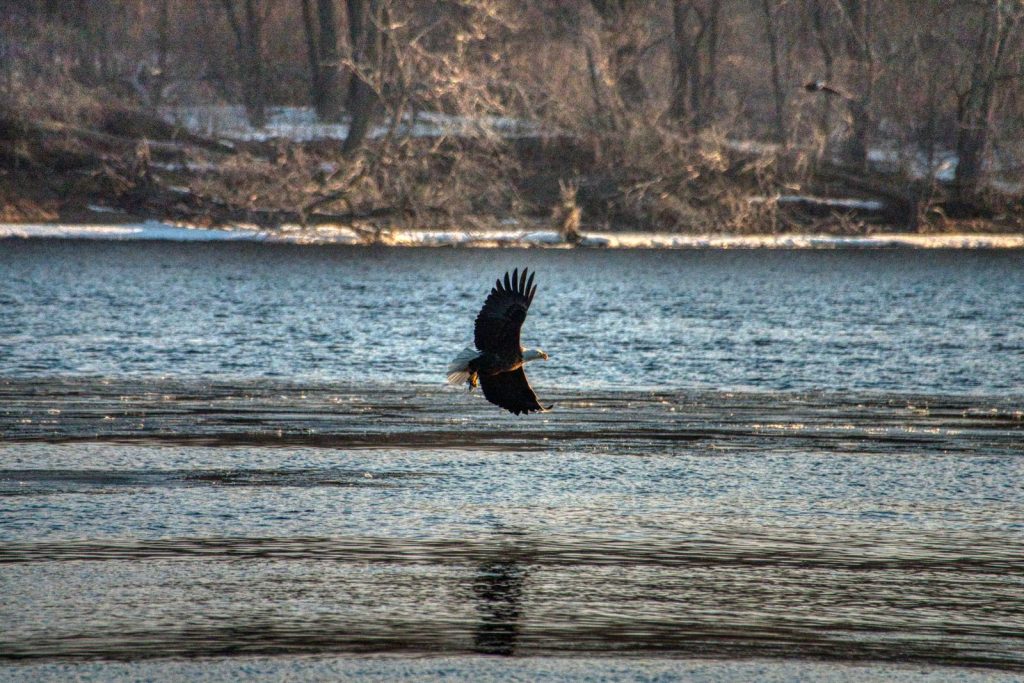
In 1963, the count of known bald eagle nesting pairs in the lower 48 states stood at 417. A federal estimate based on 2018 and 2019 data put the lower-48 total at 316,700 birds, including 71,467 breeding pairs. Few conservation stories cover that much distance, and the national symbol was at the center of it.
The recovery had no single cause. It took a change in law, a chemical ban, hand-raised chicks and the quiet work of people who protected nest trees. This is the story in order, from the bird’s choice as an emblem to its removal from the endangered list.
An Emblem Before It Was a Cause
Congress adopted the Great Seal of the United States on June 20, 1782, the same day the design arrived. Charles Thomson, the Secretary of the Continental Congress, wrote the explanatory notes, and no drawing was submitted with them. He specified an American bald eagle as the sole supporter of the shield, holding 13 arrows in its left talon and an olive branch in its right.
The first die did not obey the text. It was cut between June and September of 1782 and showed a crested eagle, which does not match the bald-eagle description. A later die from 1841 showed only six arrows and is known as the illegal seal, and the 1885 die restored all 13.
The word bald has nothing to do with baldness. It comes from an older sense meaning white-headed, or having white on the face or head. That is why a bird with a full head of feathers carries the name.
Old Abe
One of the best-known bald eagles of the 1800s was a Civil War mascot. According to the account usually given, a Lac du Flambeau Ojibwe man named Ahgamahwegezhig, known as Chief Sky, captured an eaglet in spring 1861 after the tree holding its nest was cut down. In August 1861, volunteers in Eau Claire bought the bird for $2.50, and Captain John C. Perkins named him after Abraham Lincoln.
Old Abe joined Company C of the 8th Wisconsin Volunteer Infantry on September 6, 1861. The company became Eagle Company, and the regiment became the Eagle Regiment. He rode into battle on a special perch, handled by a series of eagle bearers, and took part in campaigns including Corinth and Vicksburg. His last battle was Hurricane Creek on August 13, 1864.
The state of Wisconsin received him in September 1864 and housed him in the Capitol. He appeared at the 1876 Centennial Exposition and at a national veterans’ convention in 1880. He lived from May 27, 1861, to March 26, 1881, and his image later appeared on the insignia of the Army’s 101st Airborne Division.
His end came after a small fire in the Capitol basement in February 1881 filled his room with smoke. He declined over about a month and died on March 26. DNA testing of four of his feathers later confirmed that he was male. The preserved bird was displayed in the Capitol until the fire of 1904 destroyed it, and Jerome Case had already used his image as a trademark in 1865, a mark that was retired in 1969.
Some details are shaky. Newspapers claimed he soared over both armies’ lines at Corinth in 1862, but the man who carried him called those stories exaggerated and said a bullet cut the perch cord, so the eagle flew about 50 feet before coming back. The account of his capture comes largely from an 1865 history and a 1914 newspaper interview, with no independent confirmation.
The Bounty Years
The shooting of eagles was once rewarded. In 1917 the Alaska Territorial Legislature imposed a bounty on bald eagles, and it lasted 36 years, until 1953. A confirmed 120,195 eagles were killed under it, and the state wildlife agency says many more were killed without a payment being collected.
Federal protection started later and at first covered only part of the problem. The Bald Eagle Protection Act took effect on June 8, 1940, and it prohibited killing, selling or possessing the species. A 1962 amendment added the golden eagle and renamed the law the Bald and Golden Eagle Protection Act.
One widely repeated estimate says that 300,000 to 500,000 bald eagles lived in the lower 48 states in the early 1700s. It cites no primary source, so treat the number as a rough guess. One reference puts the count at 412 nesting pairs in the contiguous states by the 1950s, a figure close to the 417 recorded in 1963.
The Eggshell Problem
Shooting was not the only threat. After the Second World War, a new insecticide called DDT became available to farmers, and it was on public sale in the United States by October 1945. A breakdown product of the chemical, DDE, thinned the eggshells of birds of prey so badly that eggs often cracked before they hatched.
Bald eagles, peregrine falcons, ospreys and brown pelicans all suffered from this thinning, which is considered a major reason for the decline of each. Rachel Carson’s Silent Spring appeared in 1962 and brought wide attention to pesticides, though Carson never directly called for an outright ban on DDT.
A federal appeals court ordered the Environmental Protection Agency to begin de-registration procedures in 1971. In the summer of 1972, EPA Administrator William Ruckelshaus announced the cancellation of most uses, with some public-health uses exempted. In 1973 the appeals court ruled that the agency had acted properly. Canada followed with a full ban in 1989.
The Listing Timeline
The Endangered Species Act and its predecessor gave the bird legal standing in stages, and each step changed which states counted.
- 1967: the Secretary of the Interior listed bald eagles south of the 40th parallel under the Endangered Species Preservation Act.
- 1978: the species was listed as endangered in the lower 48 states, except in Michigan, Minnesota, Oregon, Washington and Wisconsin, where it was listed as threatened. It was never listed in Alaska.
- July 1995: the lower-48 population was reclassified from endangered to threatened.
- June 28, 2007: the Fish and Wildlife Service announced the bird’s recovery and removed it from the list. The delisting took effect in August 2007.
The numbers climbed along the way. States reported 9,789 breeding pairs in 2006, which is the most recent national-level figure from before delisting in the reference consulted. That is more than 20 times the count of 1963, and it came while the species was still on the list.
Raising Eagles by Hand
Law and chemistry were only part of the answer. The Fish and Wildlife Service credits habitat protection under the Endangered Species Act, the ban on DDT, and conservation efforts by the public, partners and agencies. It also names captive breeding, reintroductions, law enforcement and the protection of nest sites.
New York offers a clear example of reintroduction. The state began a hacking program in 1976 that ran for 13 years and ended in 1989. Biologists collected 198 nestlings, mostly from Alaska, and released them in New York. The eagles had been nearly wiped out in the state by the 1970s, and in 2010 New York counted 173 breeding pairs, 244 young and 224 nesting territories.
The Count That Is Not a Count
The change from 417 to 71,467 pairs is dramatic, but the two numbers are not the same kind of figure. The first is a count of known nesting pairs in 1963. The second is an estimate for 2018 and 2019. A fair comparison is rough, so the trend is certain even if the exact multiple is not.
Recovery did not end the rules. Bald eagles remain protected under the Migratory Bird Treaty Act and the Bald and Golden Eagle Protection Act, and both laws prohibit killing, selling or otherwise harming eagles, their nests or their eggs.
The older law’s reach has grown, too. Its prohibition on taking includes disturbing the birds, and it covers parts, nests and eggs.
Criminal penalties apply to anyone who possesses, sells, barters, transports, exports or imports an eagle, alive or dead.
So a bird that reached the edge of disappearing in the lower 48 states is now protected by two laws instead of one list. The emblem that Charles Thomson described in 1782 outlasted a bounty, a pesticide and a long stretch when only a few hundred nesting pairs were known. Most of the recovery traces back to choices people made once they saw the numbers fall.