
Cast-Iron Skillets: Why Families Kept Them for Generations
By Ellen Brooks · Published · 7 min read
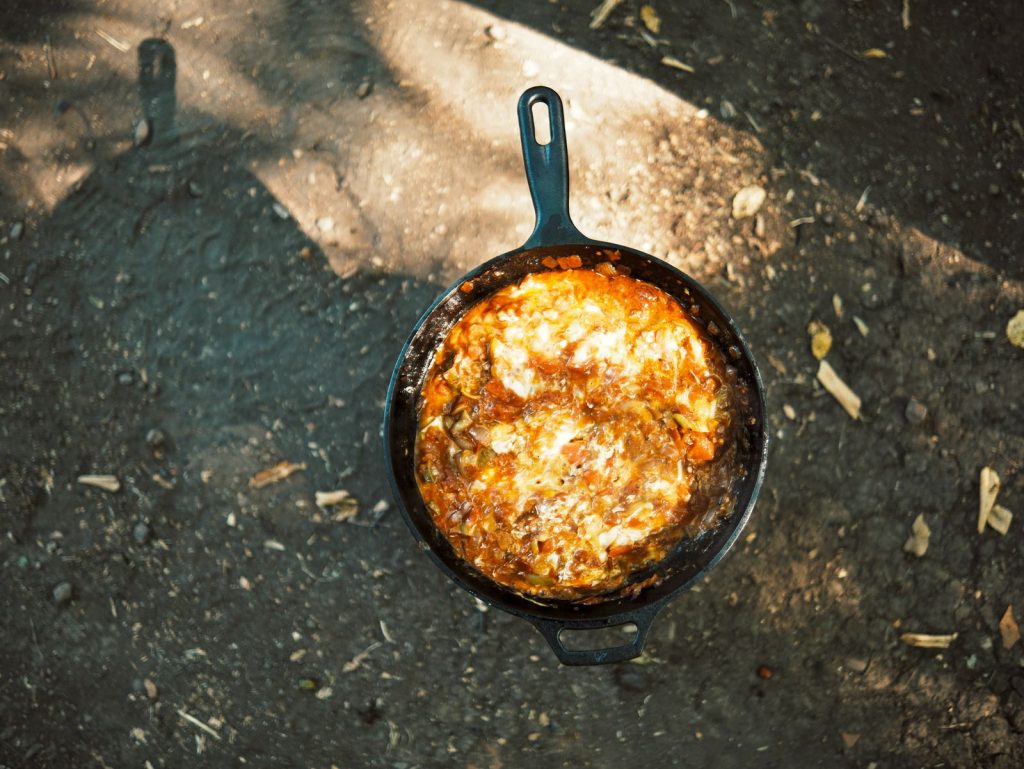
On April 18, 1707, Abraham Darby took out an English patent on a new way of casting iron pots in sand molds. Pots made this way could be thinner and lighter than the older kind, and they could be produced in quantity. The method made mass production possible, a step on the road to the iron pan in an ordinary kitchen.
A skillet is a simple object, yet it carries a surprising amount of history in its shape, its markings and even its name. This is a story of foundries, hearths and company names pressed into metal, told with the dates the sources support. Where they disagree, the disagreement stays in.
A Patent in Bristol
Darby set up the Cheese Lane Foundry in Bristol in 1704, casting pots in greensand molds. He started with brass and moved to iron in 1705, and the patent followed in 1707. The greensand method let founders make pots and cauldrons thinner than the earlier loam-mold castings, and it made mass production possible.
The credit is not entirely clear. A young Welsh apprentice named John Thomas is said to have solved the problem by using sand for the mold, with a special casting box and core, but that claim rests on a single cited source. Darby also probably visited Holland around 1704 to study the casting of brass pots, though the account does not say what he learned there.
The dates vary by source. One reference cites the 1707 patent, while another says Darby secured a patent in 1708 to produce Dutch ovens with three or four feet. The two may describe different documents, or one date may simply be wrong. Darby leased the Coalbrookdale furnace in September 1708, and it was first blown on January 10, 1709.
Cooking at the Hearth
Before kitchen stoves became common in the middle of the nineteenth century, meals were cooked at open hearths. Pots were designed to hang over the fire or to stand in it. Dutch ovens had handles for hanging or legs for standing in the coals. A close relative of the skillet was a pan called a spider, which had a handle and three legs so it could stand over a campfire or in the coals and ashes of a fireplace.
The flat-bottomed skillet with no legs belongs to the age of the cooking stove. It came into use in the late nineteenth century, when a pan could sit flat on a stovetop.
The word skillet is older than the flat pan it names. It is first recorded around 1400 as skellet, meaning a pan used for boiling or frying. Its origin is uncertain. One idea points to the Old French escuelette, meaning a little dish, and another points to an early English word for a wooden bucket or pail, possibly from Old Norse.
Names on the Bottom
Many American skillets carry a maker’s name, and the names tell a story. Griswold began as the Seldon-Griswold Manufacturing Company in Erie, Pennsylvania, in 1865, started by Matthew Griswold and two cousins, J. C. and Samuel Selden. It was renamed Selden & Griswold in 1873 and chartered as the Griswold Manufacturing Company in 1887.
In 1884 Matthew Griswold bought out the Selden family’s interests. The early products were butt hinges, stovepipe dampers and stove furniture. From the 1870s the company made skillets, pots, grinding mills and waffle irons, and later it added kettles, Dutch ovens, roasters and grid irons. Enameled items followed in the 1920s and electrical items in the 1930s.
Wagner followed in 1891 in Sidney, Ohio, founded by the brothers Milton and Bernard Wagner. Its catalog ran from frying pans, casseroles and kettles to furnace grates, feed troughs and chemists’ mortars. Wagner’s own description said its name was cast on the bottom of each piece.
Collectors read those markings like a calendar. Griswold’s logo changed over time, and the dates the sources give are as follows.
- 1910s to the early 1920s: slanted italic lettering.
- 1920s and 1930s: block lettering.
- Early 1940s: a smaller logo.
Reproductions generally have a grainy finish and uneven, blurred lettering. Collectors prize Griswold mainly for its distinctive markings and its reputation for quality.
What Seasoning Is
A well-used skillet has a dark, slick surface, and that surface has a name. Seasoning is the process of applying animal fat or vegetable oil to cast iron and cooking it on. The result is a stick-resistant coating created by polymerized oils and fats, which is a way of saying the oil bonds into a hard layer.
Two details help explain why these pans last. Bare cast-iron cookware is typically cast as a single piece of metal, handle included, so there are no rivets to loosen or joints to fail. And because the coating comes from cooking oil onto the pan, the same process that creates it can in principle build it again.
Enameled cast iron is a different product. It has a glassy enamel glaze fused to the iron, which the source says needs no seasoning. It became popular in the twentieth century.
The Companies That Vanished
The great American makers did not last as long as their pans. Randall Company, a Cincinnati car-parts maker, bought Wagner in 1952. In March 1957, McGraw-Edison acquired Griswold, and later that year the brand and its housewares division were sold to Wagner. The Erie plant closed in December 1957.
One reference lists Wagner as defunct in 1953, while its own text says the company was active from 1891 to 1952, and it does not explain the gap.
The story did not end there. Textron, which had bought Randall in 1959, sold the Wagner and Griswold lines to General Housewares Corporation in 1969. The sources are not fully consistent on when the Griswold name stopped appearing on new pans, with one section saying the early 1970s and another saying the late 1960s.
One account says that many US makers of iron cookware went out of business in the 1920s, and that others were absorbed by larger companies. The timelines are not reconciled in the source, but the reference links the later decline to the closure of nearly all US makers of iron cookware.
The Non-Stick Detour
Cast iron fell out of favor in the 1960s and 1970s as Teflon-coated aluminum cookware became popular. The new coating began with a lucky discovery. Roy Plunkett invented PTFE in 1938 while working for a DuPont joint venture, and DuPont registered the Teflon trademark in 1944. By 1951 the company had developed the material for commercial baking, but it held back at first from consumer cookware.
The material was first used for seals that resisted uranium hexafluoride during the development of the atomic bomb, and it was treated as a military secret. A French patent for coating cooking pans was granted in 1954, and the company Tefal was formed in 1956 to make non-stick pans. The source consulted does not say when non-stick pans first reached American shoppers, so that date is left out here.
The shift did not erase the old pans. The reference notes that nineteenth- and twentieth-century skillets remain in daily use, so the pans that families kept simply outlasted the trend.
The Revival
Interest came back when celebrity chefs on cooking shows began using cast iron. In the 2010s, small start-up companies began making cast-iron designs for specialty markets. The nineteenth- and twentieth-century pans never left, either. They are still in daily use in many homes, and antique collectors and dealers seek them out.
So what keeps a skillet in the family? The record offers a short list of reasons.
- One-piece construction: the pan and handle are cast as a single piece of metal.
- A coating that can be rebuilt: seasoning is cooked on, and the same method creates it again.
- A name that can be traced: many pans carry a maker’s mark that lets a family identify the company and often the decade.
- A reputation among collectors: older pans are sought by collectors and dealers who study the markings.
None of these reasons is sentimental, and that may be the point. A skillet that does not wear out gives each generation a practical reason to keep it, and the stories about it pile up afterward.