Why Birds Fly South: How Migration Works
By Ellen Brooks · Published · 7 min read
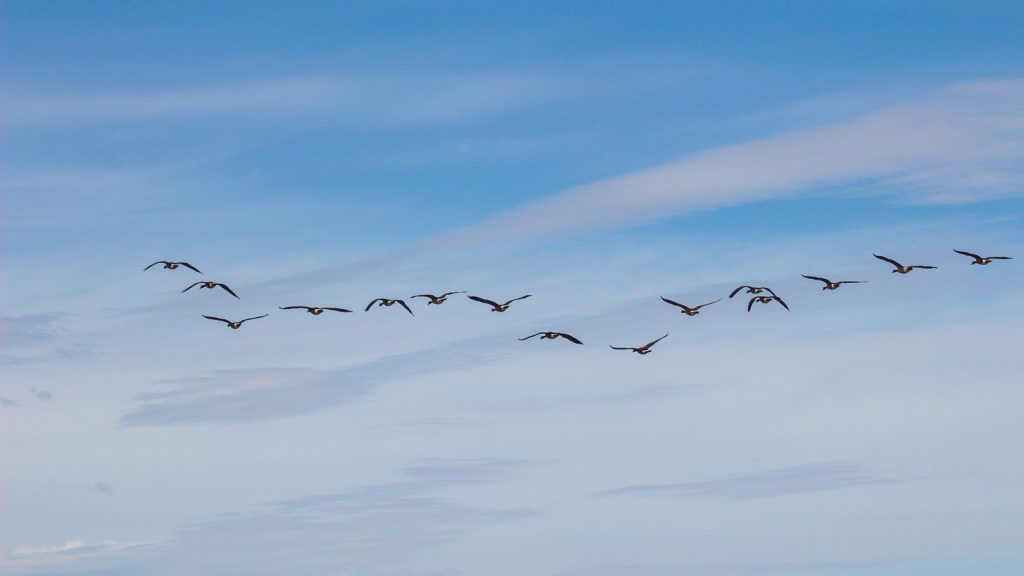
In October 2022, a young bar-tailed godwit lifted off from western Alaska and did not land again until it reached Tasmania. Tracking data showed that it flew at least 8,430 miles in 11 days and 1 hour, which was reported as a record for non-stop flight. An earlier tracked bird, a female known as E7, covered 7,260 miles from Alaska to New Zealand in eight days in 2007.
Flights like these sit at the extreme end of a common behavior. Of the world’s roughly 10,000 bird species, about 1,800, or 18 percent, are long-distance migrants. The questions are simple ones: what tells a bird to leave, how does it fuel up, and how does it find the way?
What Tells a Bird It Is Time to Go
The primary physiological cue is the change in day length, which is tied to hormonal changes in the bird’s body. Food matters a great deal as well. Some hummingbirds do not migrate at all if they are fed through the winter.
Johann Friedrich Naumann first described migratory restlessness, known by the German name Zugunruhe, in 1795. When the season arrives, birds become far more active and begin putting on fat. The restlessness shows up even in cage-raised birds that have no outside cues, which points to an inner program and not just a reaction to the weather.
Weather still adds its own influence. In a study that tracked 48 Asian houbaras, the birds timed their spring departures partly by local temperature.
Fuel for the Longest Flights
Before a non-stop flight, a bar-tailed godwit stores about 55 percent of its body weight as fat. The subspecies named baueri is the largest of the godwits, breeding from Chukotka to northern and western Alaska and wintering in Australasia. In New Zealand, these birds deposit more fat for their body size than other subspecies do. Typical fat loads in shorebirds run from 35 to 40 percent of body mass.
Fat is the main fuel, but the birds also break down some lean tissue along the way. In 2021, a male godwit flew about 8,100 miles from Alaska to New South Wales.
The strategy is not the only one. Honey buzzards migrate by soaring and lose only 10 to 20 percent of their weight during the trip. A bird that rides rising air spends less energy than one that flaps the whole way.
How Birds Find the Way
Birds seem to carry several navigation tools at once, and different species lean on different ones. The main candidates are these:
- The sun. A sun compass works only if the bird compensates for the sun’s movement across the sky, which means it needs an internal sense of time.
- The stars. In funnel cages and in a planetarium, indigo buntings chose more southerly directions on clear autumn nights, and the choice weakened as the sky clouded over. With no stars but an Earth-like magnetic field, the birds could not orient. They respond to patterns in the sky and not to any single star.
- Earth’s magnetic field. Birds can detect the planet’s magnetic field, a sense called magnetoreception.
- Landmarks and smell. Visual landmarks and odors both appear to help a bird recognize where it is.
- Mental maps. These are built through learning and experience.
The indigo bunting results come from studies that Stephen Emlen published in 1967. They suggested that the old idea of birds relying mainly on geophysical cues might be incomplete. A bird on its first trip follows a magnetic direction but does not know how far it has to go.
Four Highways in the Sky
A flyway is a flight path used by large numbers of birds moving between breeding and wintering grounds. The idea was first applied to waterfowl and shorebirds, though it fits any migrating species. The Fish and Wildlife Service recognizes four administrative flyways in North America:
- Atlantic. It runs from northern Canada and Greenland along the East Coast to the Caribbean and on to Central America.
- Mississippi. It runs from northeastern Canada over the Great Lakes, following the lower Ohio, Missouri and Mississippi rivers to the Gulf of Mexico and beyond to Central and South America.
- Central. It runs from central Canada across the Great Plains to the Gulf of Mexico, where it merges with the Mississippi Flyway.
- Pacific. It runs from Alaska and Canada to wintering areas in South America, some as far as Patagonia.
Each flyway has a council made up of representatives of state, provincial and territorial agencies. Technical committees advise the councils by reviewing population and habitat data. Frederick Charles Lincoln developed the flyway concept after the Migratory Bird Treaty Act of 1918 created a need for more information about migration.
Why So Many Fly at Night
Most migration happens between about 500 and 2,000 feet above the ground. Many species travel after dark, which lets them avoid predators and overheating and leaves the daylight hours for feeding. The cost is lost sleep, and migrants may make up for it by changing the quality of their sleep. Many give short contact calls in flight, and weather radar can estimate how many birds pass overhead each night and in which direction.
Some birds fly far higher. Bar-headed geese have been recorded by GPS at up to 6,540 meters, about 21,500 feet, over the Himalayas. Skeletons of two species have also been found at 5,000 meters on the Khumbu Glacier.
Small Bodies, Huge Distances
The Arctic tern has the longest migration of any bird. Eleven terns from Greenland and Iceland that carried geolocators averaged about 70,900 kilometers a year, or roughly 44,000 miles, and the most traveled covered 81,600 kilometers, about 50,700 miles. The study found that earlier estimates were too low because the birds take winding routes that use the prevailing winds. The species sees two summers each year, since it travels between Arctic breeding grounds and the Antarctic coast.
Other tracking studies point the same way. A bird from the Farne Islands, off the coast of England, covered about 96,000 kilometers, roughly 59,650 miles, in ten months. A ringed chick reached Melbourne in three months, a sea journey of more than 22,000 kilometers, or about 13,600 miles. Many Arctic terns live 15 to 30 years, so a single bird can pile up an enormous total.
Much smaller travelers make big trips too. The ruby-throated hummingbird weighs about a tenth of an ounce. Most spend the winter in Florida, southern Mexico and Central America, and some fly from the Yucatan Peninsula across the Gulf of Mexico without stopping, about 500 miles in roughly 20 hours.
Researchers found that these birds can roughly double their fat mass before the crossing. They burn that fat as fuel, since no food or water is available over the open water. Along the northern Gulf coast in autumn, older birds had higher body weights and larger fuel loads than first-year birds.
Audubon’s Silver Thread
In volume two of Ornithological Biography, published in 1834, John James Audubon described an experiment from his youth, written about 30 years after it supposedly happened. By his account, in the spring of 1804 at Mill Grove, Pennsylvania, he found an eastern phoebe nest in a small grotto. He tied light threads to the legs of five nestlings to see whether the local phoebes were related. The birds kept pulling the threads off, so he replaced them until the young tolerated them, and before the brood left the nest he fixed a silver thread to each leg.
The following spring, he wrote, the brood returned and settled farther up the creek and near the outbuildings. He caught several birds on their nests and found that two still wore the thread. That story earned him the label of first bird bander in America.
Historians have doubts. Dated drawings of European species place Audubon in France in the spring of 1805, not in Pennsylvania. Modern studies with much larger samples found return rates of about 1.6 percent for 549 banded nestlings and 1.3 percent for 217, far below the 40 percent his story implies. The account is considered likely apocryphal.
Whatever happened at Mill Grove, the question behind the story was a real one: do the same birds come back to the same place each year? The silver thread was an early attempt to answer it, one that historians now doubt ever happened as told.