Niagara Falls: Daredevils, Power and Myths
By Tom Brennan · Published · 7 min read
Two days before Annie Edson Taylor climbed into her barrel, a domestic cat went over Niagara Falls in it first. Rumors at the time said the cat had been killed. In fact the cat survived and was found with a bleeding head, and that was good enough for the woman who planned to follow.
On October 24, 1901, her 63rd birthday, Taylor made the trip over the Canadian side of the falls. She had been telling people she was in her forties, but genealogical records put her at 63. The falls have always drawn crowds, performers and engineers, and the stories about them are a mix of record and rumor. Europeans first read a vivid description of them in a book by Father Louis Hennepin, a priest who traveled with the explorer La Salle in the late 1670s and published his account in 1683.
The First Performers
The earliest famous stunt belonged to Sam Patch, who dove into the gorge from a ladder extended over the river below Goat Island, opposite the Cave of the Winds, in the fall of 1829. His first leap, from a height reported as more than 80 feet, drew a smaller crowd than he had hoped for. He announced a second one from a much higher perch, and by most accounts roughly 10,000 people turned out to watch him make it on October 17.
Patch’s catchphrase, that some things can be done as well as others, became a popular expression after the Niagara jump. He died less than a month later after a jump into the Genesee River at Rochester, New York, where about 8,000 people had gathered. His body was found in the ice the following spring.
Thirty years later came Charles Blondin, a French acrobat born Jean-François Gravelet. On June 30, 1859, he walked a hemp rope that stretched about 1,100 feet across the gorge, some 160 feet above the water. Later crossings included walking blindfolded, pushing a wheelbarrow, going on stilts and carrying his manager on his back. He once stopped partway across to cook and eat an omelette, and he stood on a chair balanced on one of its legs.
Barrels and a Rubber Ball
Taylor’s barrel was made of oak and iron and padded with a mattress. From launch to shore, the trip took about twenty minutes.
She was found alive with a small gash on her head, and she hoped the stunt would secure her old age. It did not. She posed for photos, gave talks and sold souvenirs, but her fame faded, and she died in 1921, aged 82, without money. She was buried in Oakwood Cemetery in Niagara Falls, in a section known as Stunter’s Rest.
She was followed by a handful of survivors, whose stories have little in common beyond the falls:
- Bobby Leach, 1911: he rode a steel barrel on July 25 and came out with two broken kneecaps and a fractured jaw. He spent six months in the hospital. Years later, on a publicity tour in New Zealand, he slipped on an orange peel, developed an infection and died.
- Jean Lussier, 1928: on July 4, he went over in a rubber ball about 6 feet across, built in Akron, Ohio, at a cost of $7,000. It was lined with oxygen tanks and tubes and held together by steel bands. The ball’s trip began about two miles above the brink, and it went over at 3:35 p.m. The ball was recovered less than an hour later, badly damaged. He had only minor bruises and became the third person known to survive the trip.
Lussier stayed in Niagara Falls, New York, and sold pieces of the ball to tourists. One account says that when the real debris ran out, he sold pieces of ordinary tires as genuine souvenirs.
The River Goes to Work
A different kind of spectacle began in late August 1895, when the Adams Power Plant went into operation. It is described as the first large-scale alternating-current generating plant in the world. Edward Dean Adams led the Cataract Construction Company, which formed an international commission in 1890 to decide how to harness the falls.
In 1893, the engineer George Forbes persuaded the company to build the system around polyphase alternating current. Westinghouse Electric built 5,000-horsepower generators based on the work of Nikola Tesla and Benjamin Lamme. Transformers stepped the voltage up so the power could travel to industries in Buffalo, Lockport and Tonawanda.
The plant was named after Adams in 1927, and the original generators ran until it closed in 1961. The transformer house earned a place on the National Register in 1975 and became a National Historic Landmark on May 4, 1983.
The Falls on a Schedule
Because so much water goes to power plants, the amount that goes over the falls is controlled by treaty. Under a 1950 agreement between the United States and Canada, at least 100,000 cubic feet per second must flow over the falls during daylight hours in the tourist season, roughly April through October. At night and in the off-season, the minimum drops to 50,000. A binational body, the International Niagara Board of Control, monitors the arrangement.
For comparison, the river’s average flow is usually given as about 85,000 cubic feet per second. Britannica puts the height of the Horseshoe Falls at 188 feet and the American Falls at 190. The curving crest of the Horseshoe Falls stretches about 2,200 feet, and the American Falls is about 1,060 feet across. Horseshoe carries about 90 percent of the river’s discharge that goes over the edge, and a large share of the river, often put at half or more, is diverted through tunnels to power plants on both sides of the border, including the Robert Moses station at Lewiston.
Myth: The Falls Froze Solid
The water at Niagara has never been recorded freezing solid, but in 1848 the flow came close to stopping. On March 29 of that year, an ice jam upstream cut it off. For as long as about 40 hours, no water fell over the edge, or at best a trickle.
That stoppage was caused by ice piling up upstream, not by the falls turning to solid ice, and no other stoppage of that kind is on record, which is why the story keeps being retold.
Myth: The Falls Are About to Disappear
Erosion is real. From 1842 to 1905, the Horseshoe Falls receded upstream at an average of about 5.5 feet a year, according to Britannica. Control works and water diversion later slowed that rate, and the current rate is about a foot per year.
The reason the falls retreat at all is the rock. The strata in the gorge are Silurian, roughly 444 to 419 million years old, and they lie nearly flat, tilting south by about 20 feet per mile. A hard layer of dolomite sits over softer shale, and the water wears away the shale underneath until the dolomite above breaks off. At the American Falls, erosion is now so slow that fallen blocks of dolomite are piling up at the base.
At that pace, the remaining 20 miles to Lake Erie would take roughly 50,000 years. The falls are moving, but not on a timescale that matters to anyone planning a visit.
Myth: The Name Has One Meaning
Nobody knows for certain where the name Niagara comes from. Several Native-language origins have been suggested:
- Ongiara, often translated as “thundering water.”
- Onguiaahra, proposed as “point of land cut in two.”
- Jaonniaka-re, which an interpreter in 1847 rendered as “noisy point or portage.”
- Onyara, a Mohawk word meaning “the neck.”
- A Seneca phrase meaning “the cliffs are standing.”
- An ethnonym, a name taken from a people called the Niagagarega, as the scholar Bruce Trigger proposed.
Each of these has defenders, and none has been confirmed.
The Summer the American Falls Went Dry
In June 1969, engineers built a temporary dam that diverted the river away from the American Falls for several months. The reason was to study the bedrock, cement cracks in it and take samples. Water returned in November of that year, when the dam was dynamited.
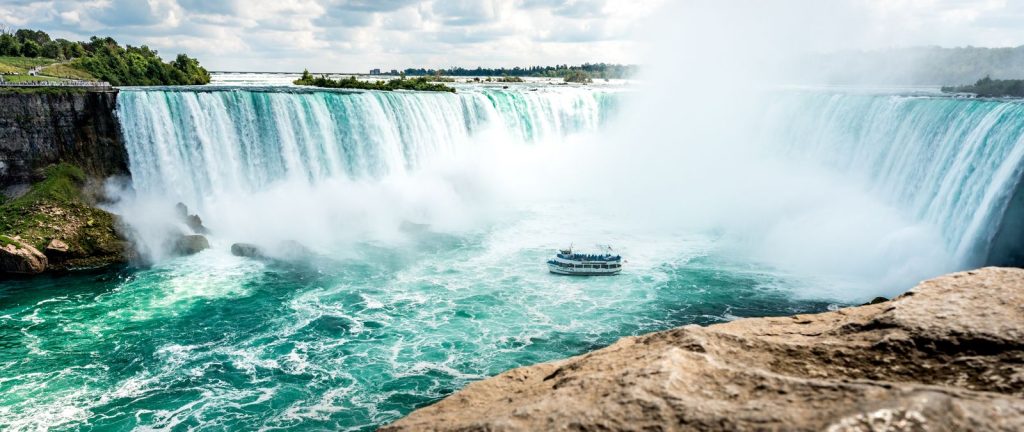
Tourists have been viewing the falls from below for much longer. A sightseeing boat called the Maid of the Mist has carried passengers into the mist at the foot of the falls since 1846.