How Mount Rushmore Was Carved
By Tom Brennan · Published · 7 min read
Every workday, the carvers on Mount Rushmore climbed hundreds of steps to reach the top of the mountain. Once they had checked in, they lowered themselves down the cliff in a seat hanging from steel cable. Between October 4, 1927, and October 31, 1941, nearly 400 men and women worked this way, and not one of them died on the job.
The finished memorial in South Dakota’s Black Hills is one of the best-known sights in the United States. The way it was made, and the story of the mountain before the carving began, are less familiar.
A Different Idea at First
The memorial began as a tourism idea, not a presidential one. According to the National Park Service, state historian Doane Robinson first imagined a parade of American Indian leaders and explorers carved into the rock. The goal was a landmark that would draw visitors to South Dakota, and the search for a sculptor led to Gutzon Borglum.
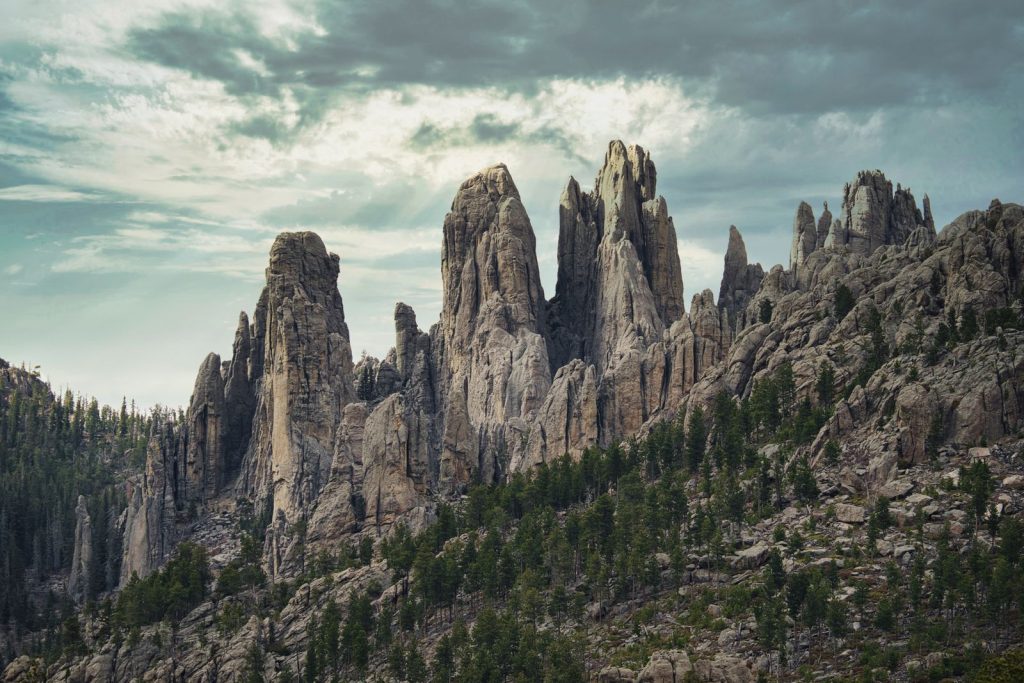
Borglum looked at the granite spires called the Needles and rejected them. He chose a granite cliff on Mount Rushmore in the Harney National Forest instead, and he chose four presidents rather than Western heroes. In his view, they represented the most important events in the nation’s history: George Washington for its birth, Thomas Jefferson for its growth, Abraham Lincoln for its preservation and Theodore Roosevelt for its development.
Getting permission took effort. Senator Peter Norbeck and Congressman William Williamson pushed the legislation. The federal land bill passed Congress easily, but the South Dakota bill was defeated twice before it narrowly passed, and Governor Gunderson signed it on March 5, 1925. The Mount Harney Memorial Association was formed later that summer to run the project.
President Calvin Coolidge attended a dedication ceremony on August 10, 1927, and promised federal funding. In 1929, Congress passed and Coolidge signed a bill authorizing federal money to match private donations, up to $250,000.
Two Names for One Mountain
The name Rushmore has nothing to do with a president. It comes from Charles E. Rushmore, a New York City attorney who was hired in early 1884 to travel to the Black Hills and secure options on the Etta mine and other tin deposits. He returned on a few later occasions in 1884 and 1885.
By his own later account, in a letter to Doane Robinson dated December 14, 1925, he asked the men with him what the granite mountain above the neighboring peaks was called. They said it had no name, and one of them replied that they would name it Rushmore Peak. Rushmore said he never tried to verify that the name was recorded in the Land Office in Washington, but the name stuck.
The cliff was not an empty canvas, either. The Lakota called it Six Grandfathers Mountain, and they call the surrounding region Paha Sapa, a phrase that means “hills of black” for the dark shadow of its evergreen trees. Religious ceremonies were held there every year, and many tribes consider the Black Hills a traditional cultural place.
The Treaty of Fort Laramie in 1868 recognized the Black Hills as Lakota territory. Gold discovered in 1874 drew prospectors and settlers in violation of the treaty, and the Black Hills War followed in 1876. In 1877, Congress passed a law taking the Black Hills and greatly reducing the reservation.
In 1980, the Supreme Court ruled 8 to 1 in United States v. Sioux Nation of Indians that the 1877 law had been a taking of tribal property, and that the United States owed just compensation. The Lakota have not accepted the money.
Step One: Build It Small
Borglum did not carve from drawings alone. He made plaster models at a ratio of 1 to 12, so one inch on the model stood for one foot on the mountain. Workers transferred measurements from the model to the rock, scaling them up twelve times.
That meant a small error on the model could grow into a large one on the cliff. Each head ended up about 60 feet tall. The whole carving sits on a mountain whose summit is at an elevation of 5,725 feet.
Step Two: Blast It Big
The surprising fact about the carving is how little of it involved chisels. About 90 percent of the rock was removed with dynamite. Powdermen set charges that took away precise amounts of granite, and the blasting continued until only a few inches of rock remained above the final surface.
Some 450,000 tons of rock came off the mountain, and it still lies in a heap near the base. The tools used on the way included:
- Pneumatic drills that cut holes for the explosives.
- Dynamite charges, sized to remove rock in controlled amounts.
- Jackhammers weighing about 75 pounds each, which carried the work between blasts.
- Hand tools for the final smoothing.
Step Three: Smooth It by Hand
Once the dynamite had done its work, the carvers switched to a method called honeycombing. They drilled rows of closely spaced holes, which weakened the granite so that workers could remove the thin walls between them by hand. The last layer was smoothed with a hand tool called a bumper or hand facer.
The result was a surface far smoother than blasting alone could produce. The big forms came from dynamite, and the refined look came from this slow work done close to the stone.
Hanging From the Face
Carvers worked from bosun’s chairs, which were seats hung on steel cables just 3/8 inch thick. Hand-cranked winches raised and lowered the chairs along the face. Several roles kept the operation running:
- Call boys, who signaled messages to keep workers safe.
- Powdermen, who handled the dynamite charges.
- Drillers and carvers, who did the work on the face.
- A blacksmith, who was part of the on-site crew.
Pay was modest, and the work was uncertain, since funding came in fits and starts.
The Faces That Moved
The plan changed as the carving went on. Borglum began Jefferson’s head on one side of Washington, but the stone proved flawed, with a crack serious enough to doom the work. After roughly two years of effort, the rock was blasted away, and the head was started again on the other side. Jefferson’s portrait was dedicated in its new place in August 1936, and Theodore Roosevelt’s followed in 1939.
An earlier plan for an inscription was also dropped. It was to be a block of text about 80 by 120 feet describing nine major events between 1776 and 1906, but it could not have been read from a distance and the space was needed for Lincoln’s head.
Gutzon Borglum died in March 1941. His son Lincoln took over the final work, and the memorial was declared complete on October 31, 1941. The total cost was $989,992.32, and the project had been under the National Park Service since an executive order in 1933.
The tourism goal that started the project did work. The memorial draws roughly two million visitors in a typical year, and most arrive by car along the same Black Hills roads that Doane Robinson hoped to fill. For the Lakota and other tribes, though, the mountain keeps an older meaning, and that history stands beside the granite faces.
The Hall That Stayed Rough
Borglum’s design called for more than faces. Behind the heads, he planned a chamber of 80 by 100 feet, reached by an 800-foot granite stairway that would rise from near his studio to the canyon behind Lincoln’s head. It was meant to hold documents such as the Constitution and the Declaration of Independence.
Work on the hall ran from July 1938 to July 1939, when a 70-foot tunnel had been blasted into the mountain. Congress then directed that work be limited to the faces, so the hall was never finished. Decades later, on August 9, 1998, a repository was placed in the floor of the hall’s entry: a teakwood box inside a titanium vault under a granite capstone. It holds sixteen porcelain enamel panels explaining how the memorial was carved and why the four presidents were chosen, and visitors cannot reach it.