Building the Golden Gate Bridge
By Tom Brennan · Published · 7 min read
Before 1937, the only way to take a car across the mouth of San Francisco Bay was by ferry. The trip from Hyde Street Pier to Sausalito took about 20 minutes and cost $1.00 per vehicle, and the ride from the Ferry Building took 27 minutes. When the Golden Gate Bridge opened, the toll was 50 cents per car, collected in each direction, and the trip no longer depended on a boat schedule.
The bridge that replaced the ferries was built over about four years, through a strait with strong currents, high winds and frequent fog. Its story includes a newspaper article, a railroad lawsuit, a banker who bought a whole bond issue and an engineer who was fired but kept working anyway.
1916: An Idea in a Newspaper
The strait itself is about a mile wide, with roughly 372 feet of water at the center of the channel. The first public proposal for a bridge came from James Wilkins, who wrote about a bridge across the Golden Gate in a 1916 San Francisco Bulletin article. The name Golden Gate Bridge was first used the following year, in 1917, long before anyone had a design or a budget. The bridge district itself was created by a 1923 act, and the name became official then.
The ferry business had been around for a long time. Ferry service began as early as 1820, and regular service started in the 1840s, at first to carry water to San Francisco. The Sausalito Land and Ferry Company opened in 1867, and the Golden Gate Ferry Company took over in 1920 before merging in 1929 with the ferries of the Southern Pacific railroad. That history helps explain why the ferry interests would later fight the bridge.
1930: A Vote, a Lawsuit and a Banker
The bridge needed money, permission and a lot of goodwill. The War Department worried that it might interfere with ship traffic, and the Navy feared a collision or sabotage could block the entrance to a major harbor. Labor unions asked for guarantees that local workers would be hired. Southern Pacific opposed the bridge as competition for its ferries, filed a lawsuit and led a boycott of the ferry service.
In November 1930, voters in the counties of the bridge district approved a bond measure of roughly $30 million. The district took in San Francisco, Marin and most of the North Coast counties, while Humboldt County opposed the bridge and did not join. The bonds could not be sold until 1932, when Amadeo Giannini’s Bank of America bought the entire issue.
The Four Names Behind the Design
Credit for the finished bridge has been argued over for decades. The people who shaped it included:
- Joseph Strauss: the chief engineer, in charge of overall design and construction. He had little experience with cable-suspension bridges and often downplayed the contributions of his collaborators.
- Charles Ellis: the principal engineer, who worked with Leon Moisseiff from a distance and designed a steel arch at the southern end so that old Fort Point would not be torn down. Strauss fired him in November 1931. Ellis kept working without pay and produced a mountain of hand calculations. In 2007, the bridge district gave him major credit for the design.
- Leon Moisseiff: the engineer who championed the final suspension design and produced its basic structure, based on his “deflection theory.”
- Irving Morrow: a consulting architect, relatively unknown for his work on houses, who designed the shape of the towers, the lighting and the Art Deco touches.
Strauss was born in 1870 and had made his name in Chicago, where his company revolutionized the design of bascule bridges, the kind with a section that swings upward. He died on May 16, 1938, just a year after the Golden Gate Bridge opened. He wrote a poem called “The Mighty Task is Done,” and a memorial statue of him stands on the San Francisco side.
Moisseiff was born in Riga, Latvia, in 1872 and came to the United States at age 19. His deflection theory held that longer bridges could be more flexible, an idea that Ellis applied to the Golden Gate. Moisseiff also designed the original Tacoma Narrows Bridge, which collapsed in a windstorm about four months after opening in 1940.
January 1933: The Work Begins
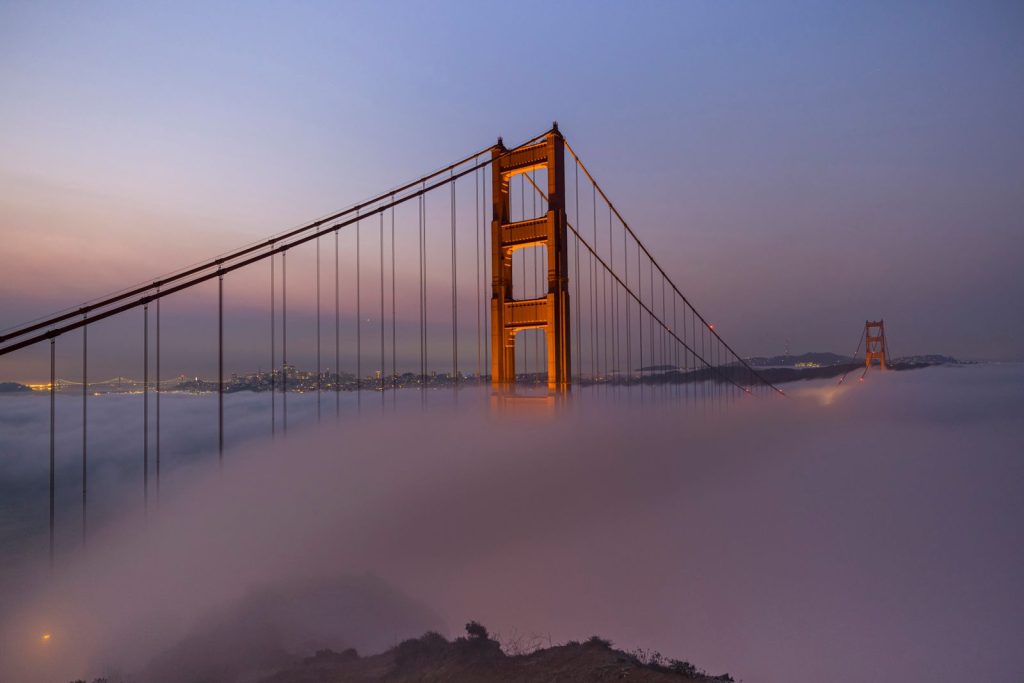
Construction began on January 5, 1933. The finished bridge has a main span of 4,200 feet, which made it the longest suspension span in the world until 1964, and towers that rise 746 feet. At its opening, it was both the longest and the tallest suspension bridge anywhere.
The structure is about 8,981 feet long overall and 90 feet wide, with six vehicle lanes and a walkway on each side. The deck sits about 220 feet above the water at high tide on average.
The project came in at more than $35 million and finished ahead of schedule. The scale of the materials is easier to picture in numbers. Each of the two main cables holds 27,572 strands of wire, and the total galvanized wire in both cables is estimated at 80,000 miles. The roadway hangs from 250 pairs of vertical suspender ropes, and each tower contains about 600,000 rivets.
The Net
Strauss introduced movable safety netting under the work area, an innovation on a job this size. Nineteen men were saved by the nets, and they formed what became known as the Half Way to Hell Club. Eleven men died in falls during construction.
Ten of those deaths happened on a single day, February 17, 1937, when a scaffold carrying twelve men fell through the net. Two of the twelve survived the fall of about 200 feet. It was the worst day of the project, about three months before the opening.
Why Orange?
The bridge’s color was not a simple matter. The U.S. Navy suggested black and yellow stripes so that ships could see it, and that idea was not adopted. Irving Morrow chose the shade officially described as an orange vermilion called international orange, because it complements the natural surroundings and helps the bridge stand out in fog. Fog shapes the structure in other ways too, since foghorns and red safety lights mark the area around the south tower.
The original paint was a red lead primer with a lead-based topcoat. A program in the mid-1960s stripped the bridge and repainted it with a zinc silicate primer and vinyl topcoats, and acrylic topcoats have been used since 1990. The district that runs the bridge describes it as painted continuously, since crews touch up corroded spots year after year.
Opening Week and the Years After
The celebration began at 6:00 a.m. on May 27, 1937, and lasted a week. About 200,000 people crossed on foot or roller skates the day before vehicles were allowed on. A student sprinter named Donald Bryan was the first to cross from end to end.
On the next day at noon, President Franklin Roosevelt started vehicle traffic by pushing a button in Washington, D.C. Weeks of events called the Fiesta followed. Pedestrians paid 10 cents to cross until December 1970.
The original deck was made of concrete, but salt-laden fog corroded the steel bars inside it. From 1982 to 1986, the road was replaced in 747 sections with steel panels about 40 percent lighter, working over 401 nights. The roadway was widened by two feet in the process, so the outside lanes are 11 feet wide and the inside lanes 10. The replacement cost more than $68 million.
The deck was designed to flex in the wind. A windstorm in 1951 showed just how much it swayed and rolled, and the bridge was closed on December 1, 1951, when gusts reached 69 miles per hour. Before 2008, it had closed for weather only three times, in 1951, 1982 and 1983.
On May 24, 1987, the bridge was closed to cars for its 50th anniversary and opened to walkers. An estimated 750,000 to 1,000,000 people turned out, and crowd control proved ineffective.
About 300,000 people were on the bridge at once, and the center span flattened under the weight. Officials estimated afterward that the cables never exceeded 40 percent of their yield stress.