How the Statue of Liberty Came to America
By Tom Brennan · Published · 7 min read
When the Statue of Liberty reached New York Harbor on June 17, 1885, it arrived in pieces. The French navy ship Isère carried it across the Atlantic packed in more than two hundred crates, and then the crates sat in storage for about a year. The pedestal that was supposed to hold the statue was not finished, and the money to complete it had nearly run out.
That delay says a lot about the project. The statue was never the work of one person or one country, and it took six very different people, plus tens of thousands of ordinary donors, to get it standing on its island.
Édouard de Laboulaye, the Man With the Idea
The idea is credited to Édouard de Laboulaye, a French historian and legal scholar who was also an outspoken opponent of slavery. Around 1865, as the American Civil War ended, he proposed that the people of France present a statue to the United States. It would honor the friendship between the two countries and celebrate the American republic as it neared its hundredth birthday.
Laboulaye admired the American system of government and wrote about it at length. A monument to liberty, he believed, could also be a quiet message to his own countrymen, who were then living under an emperor.
The plan was a shared one. France would build the statue and the United States would build the pedestal, and the hope was to finish in time for the 1876 centennial. Raising money on both sides took far longer than expected, and the date slipped by years.
He was a thinker rather than a builder, so he needed a sculptor to turn the idea into something that could be seen from a boat.
Auguste Bartholdi, the Sculptor
Frédéric Auguste Bartholdi began designing the figure around 1870 and called it Liberty Enlightening the World. In 1871 he sailed to the United States to promote the plan and scout locations, and he chose a small island in New York Harbor, then called Bedloe’s Island.
Bartholdi had a history with colossal statues. In the late 1860s he pitched a gigantic lighthouse figure for the entrance to the Suez Canal in Egypt, but the plan was turned down over cost. Some writers see the torch-bearing woman as a descendant of that idea.
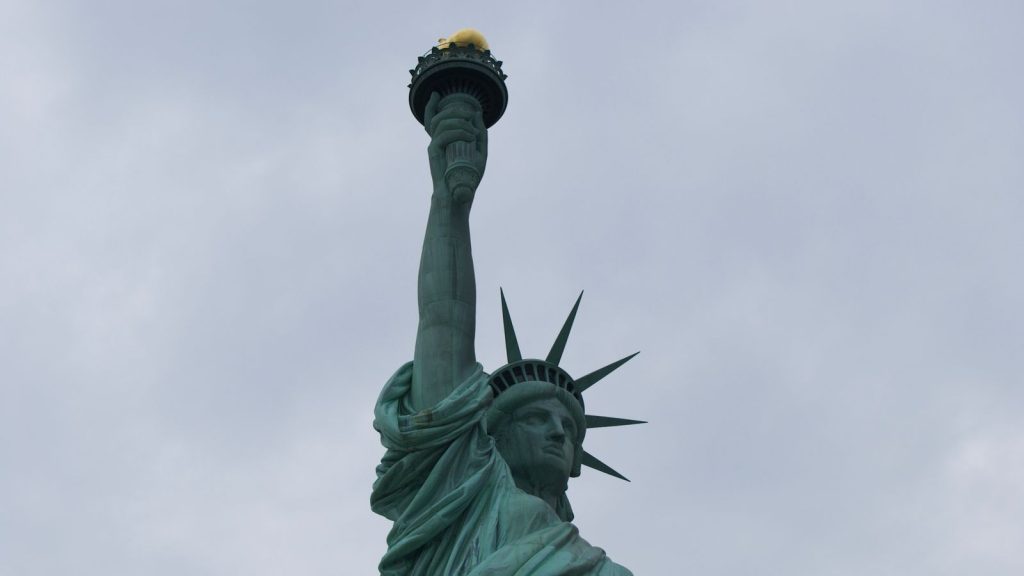
The figure itself is Liberty, a robed woman in the tradition of the Roman goddess Libertas. Her left hand holds a tablet inscribed with the date of the Declaration of Independence, July 4, 1776, written in Roman numerals. The crown’s seven rays are often said to stand for the seven seas and seven continents, though no one has confirmed that this was the sculptor’s intent.
Popular accounts claim he modeled the face on his mother. A curator at the Bartholdi Museum has said there is no basis for the claim, so it is best treated as a legend.
The pieces were made in France and shown off along the way:
- 1876: the torch-bearing arm was finished and displayed at the Centennial Exposition in Philadelphia. It then stood in New York’s Madison Square Park until 1882.
- 1878: the head and shoulders appeared at the Paris Universal Exposition.
- July 4, 1884: the finished statue was formally presented in Paris to the American minister to France.
- June 17, 1885: the dismantled statue arrived in New York.
Gustave Eiffel, the Skeleton Inside
A statue this large could not be solid. The first engineer on the project, Eugène Viollet-le-Duc, died in 1879, and Bartholdi turned to Gustave Eiffel, whose firm would later build the famous tower in Paris.
Eiffel designed an iron framework built around a tall central pylon, with a lighter network of supports holding the skin. The arrangement lets the thin copper shell move independently of the core in strong winds instead of tearing loose.
The skin itself is about three thirty-seconds of an inch thick. Workers shaped it through a technique called repoussé, hammering copper sheets over forms built from the sculptor’s enlarged models. Piece by piece, the sheets were riveted together on the framework.
On the island, the whole process ran in reverse. The statue was taken apart in Paris for shipping, and in 1886, once the pedestal was ready, the iron framework went up first and the copper pieces were fastened to it.
Richard Morris Hunt and Joseph Pulitzer, the Foundation
France paid for the statue, and Americans agreed to supply the pedestal. The design came from the architect Richard Morris Hunt, one of the best-known American architects of his day and the designer of the Biltmore estate in North Carolina. He set the base inside the walls of Fort Wood, a star-shaped fort on the island that dated from the early 1800s.
Fundraising was slow, and by 1884 the committee in charge had run short. Joseph Pulitzer, the publisher of the New York World, stepped in with a newspaper campaign. His March 1885 appeal urged ordinary readers to send in whatever they could spare.
The response was striking. In about six months, roughly 125,000 donors sent in more than $100,000, and most gave a dollar or less. The World printed the name of every contributor, however small the gift, which also helped sell papers.
Emma Lazarus, the Poet
In 1883, the poet Emma Lazarus wrote a sonnet called “The New Colossus” for an art and literary exhibition that raised money for the pedestal. She had declined the request at first, and it took a friend, the writer Constance Cary Harrison, to talk her into it. The exhibition opened on November 2, 1883, with her poem read first.
The title looks back to the ancient Colossus of Rhodes, a bronze giant of the Greek world, and sets the new statue against it.
After the exhibition closed in 1885, the poem was largely forgotten, and it was not part of the 1886 dedication. Lazarus died in 1887 at the age of thirty-eight. In 1901 her friend Georgina Schuyler began an effort to honor the poem, and in 1903 a bronze plaque inscribed with it was installed inside the pedestal.
A piece written for a single fundraiser outlasted the fundraiser and became a permanent part of the monument.
Dedication Day, October 28, 1886
The statue was dedicated on October 28, 1886, with President Grover Cleveland in attendance. A parade moved through Manhattan that morning, and estimates of the crowd range from several hundred thousand to a million. Only dignitaries were permitted on the island itself, and bad weather pushed a planned fireworks display back to November 1.
One moment went off script. Bartholdi had arranged for a French flag to cover the statue’s face, and he let it fall early, interrupting a speech by Senator William Evarts, who was in the middle of his remarks. The crowd’s cheers drowned out the rest.
Cleveland’s own remarks looked forward. He said the statue’s light would pierce the darkness of ignorance and oppression.
Some accounts say that Wall Street traders tossed ticker tape from their windows as the parade passed, and that this started the ticker-tape parade tradition. The story is often repeated, though the details differ from one telling to the next.
From Shiny Brown to Green
The new statue was not green. The copper was a bright reddish-brown, like a new penny. A green patina called verdigris began to spread after about 1900, was noted in the press by 1902, and had covered the whole surface by 1906.
The color came from natural weathering rather than paint. Exposure to rain, wind and sun oxidized the copper, and the resulting coating also protects the metal underneath.
For some time, the government treated the statue as a navigation aid. The U.S. Lighthouse Board took charge of it in 1887 and held it until 1901, when it passed to the War Department. The torch’s light was too faint to guide ships, though, and the statue was nearly invisible at night.
The island itself changed names along the way. Bedloe’s Island became Liberty Island in 1956, through a joint resolution of Congress signed by President Eisenhower. The statue had already been named a national monument in 1924 by President Calvin Coolidge.
One more detail points to the statue’s original theme. At her feet lie a broken chain and shackle, mostly hidden by the folds of her robe, and the National Park Service describes them as a symbol of the abolition of slavery.