Soda Fountains and Malt Shops: America’s First Hangouts
By Diane Porter · Published · 8 min read
In 1806, a Yale chemistry professor named Benjamin Silliman bought a device for saturating water with gas and started selling the fizzy result as mineral water. Nobody was thinking about dessert. Carbonated water was sold as something close to medicine, and the people who knew how to handle it were druggists.
That medical origin explains why American soda fountains sat in the corner of the corner drugstore for generations. Over about a century they went from a curiosity to a place where neighbors traded news and everyone knew the person behind the counter. Here is how it happened, one question at a time.
Why did soda come from the drugstore?
Scientists in the eighteenth century had tried to copy the sparkling water of natural springs, which many people believed had healing powers. Torbern Bergman in Sweden and Joseph Priestley in England each built equipment in the early 1770s that pushed carbon dioxide into water. The product became known as soda water, even though it contained no sodium bicarbonate.
Druggists were the natural sellers. Early in the nineteenth century, some of them made the fizz in the basement and served it through a spigot upstairs. In 1832, John Matthews of New York built a compact machine that made and dispensed soda water, and the drugstore soda counter as a piece of furniture began to take shape.
Plain carbonated water was not much of a treat on its own. A Philadelphia perfume maker named Eugene Roussel is credited with combining fruit syrups with the fizz in the late 1830s, and that step created flavored soda. Once the syrups arrived, the drugstore counter had a drink people wanted for pleasure instead of a cure.
Making the equipment turned into a business of its own. John Lippincott in Philadelphia began manufacturing fountains the same year as Matthews, and names such as Alvin Puffer, Andrew Morse, Gustavus Dows and James Tufts followed. In 1891, Tufts, Puffer, Lippincott and Matthews joined forces as the American Soda Fountain Company. It worked as a trust that controlled prices and pushed out smaller makers, and it was later broken up.
Who poured the first ice cream soda?
The most common answer is Robert M. Green, who sold soft drinks at the Franklin Institute exhibition in Philadelphia in 1874. One version of his story says he ran out of cream and tried ice cream instead. In another, which historians treat as more reliable, he noticed people eating ice cream alongside plain water and put the two together.
Other people have claimed the invention. A Detroit candy maker named Fred Sanders told a similar tale, but his shop opened in 1875, after Green’s exhibition. Philip Mohr of Elizabeth, New Jersey, is said to have mixed ice cream into soda water in 1862 for a customer who wanted a colder drink, though that claim has never been firmly verified. A former Green employee named George Guy later told a story about dropping ice cream into vanilla soda by accident.
None of those claims can be proven, and the swap is simple enough that two people could have tried it independently. What is certain is that by 1876, a giant fountain at the Centennial Exposition helped make soda counters more fashionable than the old ice cream saloons.
By 1900, the menu at many fountains included named drinks that Americans knew from advertising, such as Hires root beer, Moxie, Dr Pepper and Coca-Cola. Fountains had become the places where nationally advertised drinks were poured, one glass at a time.
How did they keep it all cold?
Before mechanical refrigeration, a fountain depended on ice that had been cut from lakes and ponds in winter and stored in ice houses. That meant a fountain’s summer supply depended on the winter weather and on how well the owner could store the ice.
In the early 1900s, makers began selling “iceless” fountains that were cooled by brine, which is salt water chilled below freezing and circulated through pipes. During World War I, some fountains combined ice with mechanical cooling. By the early 1920s, ammonia refrigeration had become common.
Better cooling changed what a fountain could do. With it, a counter could stock ingredients for sandwiches and light meals as well as syrups and ice cream. That is how many soda counters grew into lunch counters.
What did a soda jerk actually do?
The soda jerk was the person behind the counter, named for the way he jerked the handle that dispensed syrup or fizz. At first a fountain dispensed only plain carbonated water, and the syrups were added by hand. Over time the menu grew to include ice cream sodas, egg creams, sundaes and floats.
The job took skill. A good jerk could build a sundae, a float or a flavored phosphate quickly while keeping a line of customers entertained.
Soda jerks also developed their own slang, and it varied from shop to shop. One reported example is that “thirteen” served as a quiet warning that the boss was near. Because the lingo was passed along by word of mouth and never standardized, some of the phrases that appear in nostalgic lists were probably local jokes.
Where did malt shops get their name?
Malted milk was not invented for fun. The Horlick brothers, a London pharmacist named James and his brother William, developed it as an improved supplement for infants and invalids, and William Horlick received a U.S. patent for it on June 5, 1883. The company trademarked the term “malted milk” in 1887.
The powder had an easy path onto the fountain, where it became a standard offering. When someone blended it with ice cream into a malt, the drink caught on so strongly that the shops that served it came to be called malt shops. The record does not settle who first blended a malted milkshake.
That is why “soda fountain” and “malt shop” overlap in memory. Both names describe the same long counter and the same row of stools.
Why did Prohibition help?
The years from 1920 to 1933, when the sale of alcohol was banned across the country, gave the soda fountain a boost. Accounts of soda fountain history commonly say that Prohibition greatly increased the fountain’s popularity, with the counter filling part of the gap left by the saloon as a place to sit and talk.
By the 1920s, better refrigeration let fountains serve meals, and counters turned up in a long list of places:
- Drugstores and pharmacies
- Ice cream parlors and candy shops
- Five-and-dime stores and department stores
- Luncheonettes, tobacco shops and grocery stores
- Milk bars and train stations
One reference describes the golden days of the fountain as running from the late nineteenth century into the early 1940s. In those years the counter was more than a drink stop. It was a neighborhood fixture where people exchanged news.
Who was welcome at the counter?
Not everyone could sit down. In much of the South, many lunch counters served only white customers, and Black customers were turned away from the stools.
On February 1, 1960, four students from North Carolina Agricultural and Technical State University went into a Woolworth store in Greensboro, North Carolina. Ezell Blair Jr., Franklin McCain, Joseph McNeil and David Richmond bought small items, then sat down at the whites-only lunch counter and politely asked to be served. The staff refused. The four stayed in their seats, and police who arrived said they could do nothing because the young men were paying customers who had not been disorderly.
The protest returned the next day with about twenty more students. National news coverage carried it across the country, and within weeks sit-ins at lunch counters began in cities far from Greensboro. By July 1960, the Greensboro Woolworth’s counter was serving Black customers. The row of stools that people remember so warmly was also a place where the country argued about who belonged.
What happened to the stools?
The decline came from several directions at once. During World War II, soda jerks were drafted into the service, sugar was rationed, and equipment makers turned to war production. After the war, fountains had a brief comeback but never regained their old popularity. Some operators found they made more money selling cosmetics and nylon stockings than ice cream sodas, so the counter shrank or vanished.
In 1950, Walgreens introduced full self-service drugstores, a format that left less room for a staffed counter. Cars, suburbs, drive-ins and roadside ice cream stands gave families other places to go. Retailers also moved to self-service machines for canned drinks, a model that did not suit a fountain that needed a person behind the counter.
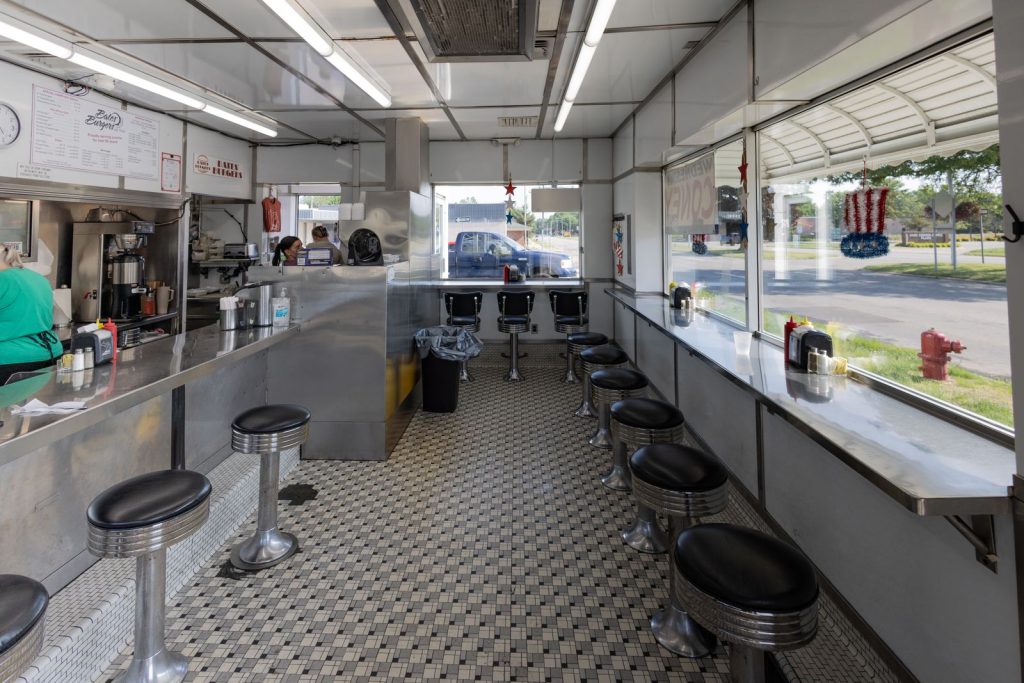
A few vintage fountains survive in towns and old drugstores across the country, and visitors still sit on a stool, order a float and watch a hand pull the lever. It is a long way from Silliman’s mineral water, but the fizz at the center of it never changed.