How a Dropped Spring Became the Slinky
By Diane Porter · Published · 7 min read
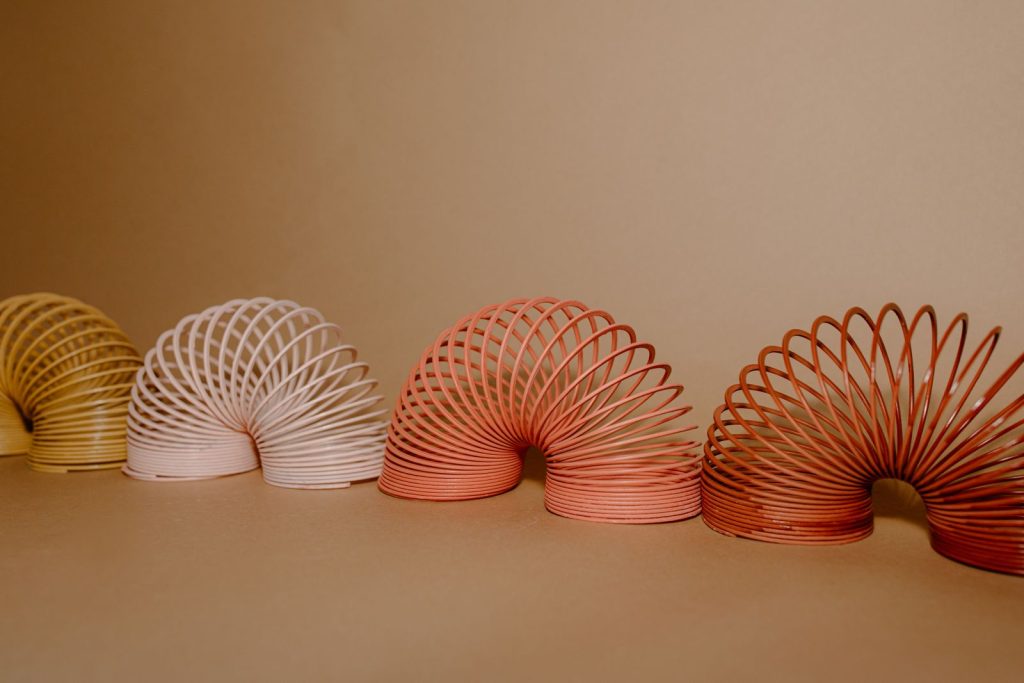
A Slinky is a single length of flat steel wire, about 80 feet of it by the usual accounts, wound into 98 coils that rest snugly against one another. Pull it straight and the toy becomes a long ribbon of metal. Let go of one end and it folds back into a stack only a couple of inches tall.
Eighty Feet, One Piece
That simple shape took some engineering to produce. The wire has to be springy enough to remember its form, yet workable enough to be coiled by machine. One account says Richard James built machines that could wind the full length in about ten seconds, which would make the manufacturing method as much an invention as the toy itself.
The story begins in the Philadelphia area during the Second World War. It involves a falling spring, a dictionary and a department store counter. A few details change depending on who tells it, and those are worth separating from the parts that most sources share.
A Spring That Walked Off the Shelf
In 1943, Richard T. James was an engineer working on springs meant to steady delicate instruments aboard ships. A vessel at sea pitches and rolls, so gauges and equipment need something to cushion them.
In the popular version, a spring slipped off a shelf, and instead of clattering to the floor it stepped over itself in a series of arcs and settled upright again. James noticed, and the idea of a toy took shape.
Retellings present this scene as a popular story, not as a documented event. Some accounts place him at the Cramp Shipbuilding Yard in Philadelphia, while another describes a home laboratory. Most accounts give the year 1943 but no exact day.
What came next was slow work. James tried different steels and different tensions for somewhere between one and two years, depending on the account. He was looking for a wire that would keep walking without tangling or going slack.
One source says the Navy never showed interest in the springs themselves. If so, the toy was a side result of wartime research rather than a military product.
A Name From the Dictionary
His wife, Betty, supplied the name in 1944. She went through a dictionary and settled on slinky, a word that describes something sleek and graceful in its movement. Some retellings claim the name imitates the sound of the toy in motion, but the standard account credits the dictionary.
The couple took out a $500 loan and formed James Industries. They made about 400 of the toys by hand and tried to place them in Philadelphia stores. Few buyers were interested, which seems strange for a toy that later sold in the hundreds of millions.
Ninety Minutes at Gimbels
The turning point came at Gimbels, the big department store in downtown Philadelphia, during the 1945 holiday season. The toys sat on the counter, and at first sales were slow. Then James set up a sloped board and let the spring walk down it while shoppers watched.
By the usual account, all 400 sold in about ninety minutes at a dollar each. One source dates the demonstration to Tuesday, November 27, 1945, the Tuesday after Thanksgiving. The lesson was simple: a label could not explain the motion, but a demonstration could.
A patent followed in January 1947. Sales were strongest in the late 1950s and then began to fall.
Details That Change With the Teller
Anyone who reads several versions of the Slinky story will notice that the numbers do not always match. Here is where the sources disagree:
- Where the idea began: a shipyard in Philadelphia in some accounts, a home workshop in others.
- How long the sellout took: about ninety minutes in most versions, and under two hours in at least one.
- How many sold that season: one account says nearly 20,000 by the end of the 1945 holiday season, but other sources do not mention it.
- Lifetime sales: totals from about a quarter of a billion to about 300 million are quoted, depending on the year and on what counts as a Slinky.
- How the name was chosen: from a dictionary search in the standard version, from the sound of the toy in a popular legend, and from stair-walking experiments in one source.
- When television advertising began: 1962 in one account, 1963 in another.
None of this changes the outline. It does mean that any single crisp number deserves a little suspicion.
Betty Takes the Wheel
By the end of the 1950s the business was in trouble. Richard reportedly gave large sums to religious groups, and the company drifted toward bankruptcy. In 1960 he left for Bolivia to join a missionary organization, leaving Betty with six children and a company that owed money.
Betty took over James Industries and ran it for almost 40 years. She pushed television advertising in the early 1960s, and by one account she mortgaged the family home in 1963 to pay for a trip to a New York toy show, where the Slinky sold out again. She also held the price down, at $1 in 1945 and roughly $1.89 to $2.69 for the plain metal version in 1996.
Over the decades the line also grew beyond the original steel coil. A plastic version received a patent in 1978.
A pull toy shaped like a dog, with a Slinky for a body, helped widen the line. Inventor Helen Malsed patented it through James Industries in the 1950s, and she reportedly earned a steady royalty for years without ever visiting the plant. The dog was redesigned for the 1995 Pixar film Toy Story, and reports at the time of Betty’s death credited the film with helping to reverse a sales slump.
She sold the company in 1998 to a Michigan firm, POOF Products. Betty James died in 2008 at the age of 90.
Beyond the Toy Box
Physics teachers adopted the Slinky as a classroom prop, because a stretched coil shows how a push or a pulse travels along a spring. Some reports say soldiers in Vietnam used metal Slinkys as improvised radio antennas. Those accounts rest on a magazine retelling, and the details are thin.
The toy also went into space. In 1985, astronauts aboard the space shuttle Discovery recorded a video of how toys behave in weightlessness, and a Slinky was part of the demonstration. In orbit, the coils do not walk down anything, because there is no downhill.
Astronaut Margaret Rhea Seddon is the crew member named in one magazine account of the demonstration. The National Toy Hall of Fame added the Slinky in 2000, and Betty James entered the Toy Industry Hall of Fame the following year. For a product that began as a failed ship-spring experiment, it earned a remarkable amount of formal recognition.
The Hovering Bottom
Hold a Slinky by its top coil and let it hang at full stretch. Now let go. The bottom stays in the air for a moment, as if nothing had happened.
Physicist Shimon Kolkowitz worked out that the pause lasts about 0.3 seconds for a metal Slinky. The explanation is that the top coils collapse together first, and that compression travels down the spring as a wave. The bottom coils have no way of knowing the top has been released until the wave arrives, so they stay put until then.
The center of the toy falls the whole time, so gravity is not being ignored. The writer Martin Gardner posed the puzzle in 2000, and physicist Bill Unruh later published an analysis of the shock wave inside the spring. According to Kolkowitz’s calculation, the length of the pause depends on the spring’s mass and stiffness rather than on how strong gravity is.
The toy’s best-known trick is easier to picture. On a flight of stairs, the leading end drops onto the next step, and the momentum of the rest of the spring carries the trailing end up and over to land below. Level ground will not do, since the toy needs a slope or a set of steps to keep going.
That is a fitting last surprise. A toy that began with one falling spring still has a way of making a falling spring look like it is breaking the rules.