Rotary Phones and Party Lines: How Calls Used to Work
By Diane Porter · Published · 7 min read
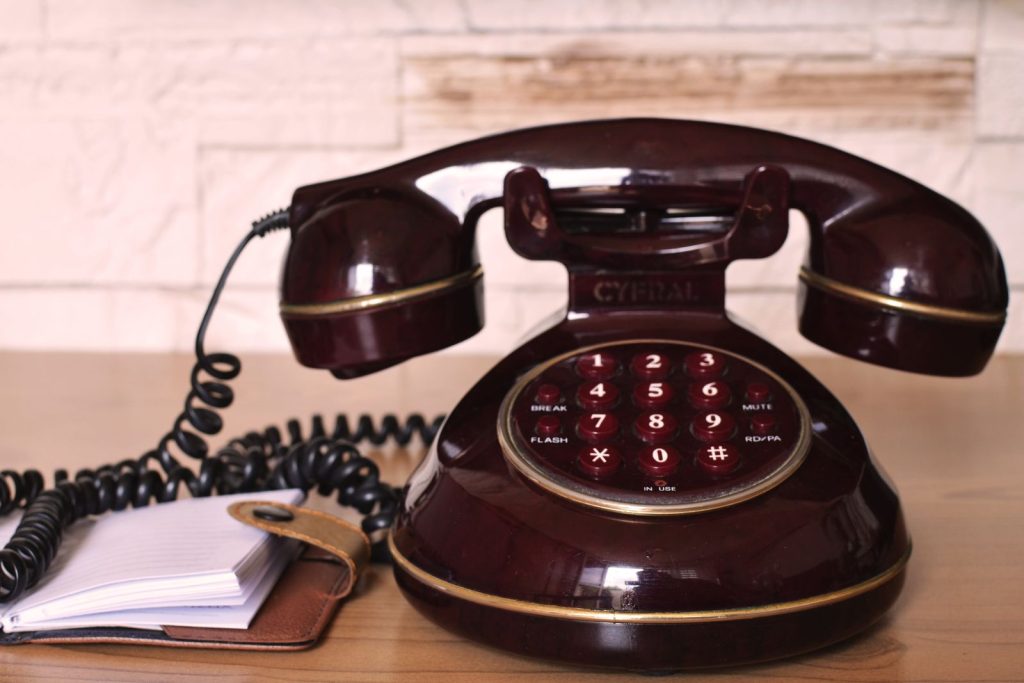
The first model of an automatic telephone exchange was built from a cardboard collar box. Pins stood in for the lines, and a pencil served as the shaft that swept across them. The man who made it, Almon Strowger, was an undertaker in Kansas City, and his homemade prototype led to the dial that millions of Americans spun for most of the twentieth century.
The rotary phone and the party line belong to the same story. One changed how people placed a call, and the other changed who else might be listening when they did.
The Undertaker’s Idea
Most historians agree that Strowger was spurred by a suspicion that callers asking for his mortuary were being connected to competitors. The details are in dispute, so that motive is best treated as the accepted account rather than a certainty. What is documented is the result. On November 3, 1892, Strowger and his partners opened an automatic exchange in La Porte, Indiana.
Strowger did not stay long. He retired to Florida about six years after opening the exchange, selling his patents for $1,800 and his stake in the company for $10,000. He died in 1902. In 1916, the Bell system licensed the invention for $2.5 million.
How a Dial Really Worked
The finger-hole dial came later than the first exchange. Strowger’s first dial had lugs on a finger plate rather than holes, and the familiar design with holes did not appear until about 1907, according to one account. The earliest dials turned forward and were prone to errors. Later versions used a recoil spring and a centrifugal governor.
The mechanism was simple in idea. Turning the wheel clockwise wound a return spring, and when the user let go, the spring pulled the wheel back at a speed set by a governor. During that return, a switch briefly interrupted the current on the line, and each interruption was a pulse that the exchange counted.
A typical dial sent about ten pulses per second, though the system accepted roughly nine to thirteen because governor speeds varied. Each digit produced a number of pulses matching its value. A curved metal stop, called the finger stop, marked the end of the turn.
The Phone in the Hall
The most familiar rotary telephone in American homes was the Western Electric Model 500. AT&T announced it in 1949, and it reached Bell operating companies on May 1, 1950. It remained the standard desk set until the Bell System was broken up in 1984.
An industrial design firm led by Henry Dreyfuss created the line in cooperation with Bell Laboratories. All of the working parts sat on a steel base plate beneath a molded plastic housing, and the numbers and letters on the dial were molded into the plastic.
The phone drew its power from the telephone line itself. It also had a loudness control for the ringer on the bottom of the case, although users could not simply turn the ringer off. Development began in 1946, and field trials with 4,000 sets took place in 1949.
Color arrived in stages. From 1950 to 1953, the phone came only in black. Colors were added in 1954, including ivory, green, red, brown and yellow, and pastel shades followed in 1957. Turquoise was added in 1964.
One more detail may come as a surprise. Customers did not own these phones. Local Bell companies owned them and leased them by the month, and most sets from about 1968 carried a molded notice that they were Bell System property and not for sale. Only after the 1983 divestiture did AT&T begin selling phones outright.
Numbers With Names
Until the 1950s, a typical phone number was the name of an exchange followed by digits. The first letters of the name matched positions on the dial, so a number written as CHelsea 2-5034 was actually dialed as 2-4-2-5-0-3-4. A 1947 nationwide plan standardized the format of two letters and a digit as the office prefix, and it was projected to last well beyond the year 2000.
Growth forced a change. By the late 1950s, planners expected the system to run out of combinations by about 1975, and AT&T chose to drop names altogether. AT&T researcher John Karlin had led a study of memory and dialing accuracy in 1954, and a test on January 19, 1958, in Wichita Falls, Texas, found far fewer dialing errors with all-digit numbers than with the older style. In March 1960, Council Bluffs, Iowa, which had about 26,000 subscribers, made the switch with no major resistance.
The new system meant ten-digit numbers, made of a three-digit area code, a three-digit central office code and a four-digit station number. AT&T even released an instructional film in 1961, titled Mr. Digit and the Battle of Bubbling Brook.
Not everyone cheered. In 1962, introductions in California drew strong opposition from city residents, who called all-digit dialing dehumanizing. Groups such as the Anti-Digit Dialing League and the Committee of Ten Million to Oppose All-Number Calling formed to protest.
Sharing a Line
Millions of households had a different arrangement altogether. A party line was a single local loop shared by several subscribers. Early rural lines sometimes served several dozen subscribers, and one West Virginia town once had as many as sixteen on a single line.
To tell the calls apart, each household had its own ring pattern. This was called code ringing, and a pattern was usually made of long and short rings. Another method, divided ringing, gave full selectivity for two parties, and combined with code ringing it could stretch to four or eight. A listing might read as a line number followed by “R” and two digits, such as 93R22.
The system had obvious limits:
- Any phone off the hook tied up the line for everyone on it.
- Privacy was minimal, because any party could pick up and listen.
- Heavy talkers drew complaints, and the problem became a common subject in popular culture.
- Long-distance calls often went through an operator, so that the calling party could be identified and billed.
- Emergencies had priority, and many places required callers to hang up at once if someone needed the line.
The emergency rule was enforced. In 1955, a woman in Rhinebeck, New York, was indicted after refusing to yield the line during a grass fire, and she received a suspended sentence.
How Common Were They?
A majority of Bell System subscribers in the mid-twentieth century were on party lines, which carried a discount compared with individual service. In Pennsylvania in 1943, nearly three-quarters of residential service was party line, and users were encouraged to keep calls to five minutes.
War shortages made party service the only option in many places, and shortages persisted afterward. Florida was still dealing with them as late as 1948. Busy lines and congestion were common, especially after World War II.
The Buttons Arrive
Push-button dialing was shown to the public at the 1962 World’s Fair. Touch-Tone service began on November 18, 1963, in Carnegie and Greensburg, Pennsylvania. Customers who paid an additional fee received a Western Electric phone with ten push buttons.
The star and pound keys were added later, with one account dating the model that carried them to 1968. Rotary dials were gradually supplanted from the 1960s onward, although they did not vanish at once.
According to one book, rotary pay phones were reinstalled in a Washington neighborhood in the 1980s to discourage drug-related loitering.
Party lines faded more slowly. By the late 1980s, most places had removed them. Answering machines and modems did not work well on shared lines, old switching equipment was becoming obsolete, and party lines were not eligible for certain federal subsidies. The West Virginia town that once had sixteen on a line converted in 1989, and Southwestern Bell closed its last Texas party line in 1996.
The rotary dial’s legacy lives on in a single word. Americans kept saying they were “dialing” a number long after the wheel itself disappeared.