Big Band Swing: The Sound of the 1940s
By Greg Lawson · Published · 7 min read
On August 21, 1935, Benny Goodman’s band played the Palomar Ballroom in Los Angeles, and the response was close to a riot. Britannica says that night is considered the beginning of the swing era. The performance was broadcast nationally, which meant that listeners far from California heard what the dancers heard.
Within a few years, big bands filled ballrooms, radio schedules and jukeboxes across the country. The sound was loud, precise and meant for dancing. It also turned out to be fragile, because by the middle of the 1940s the bands were being pushed aside by forces that had little to do with music.
How a Big Band Was Built
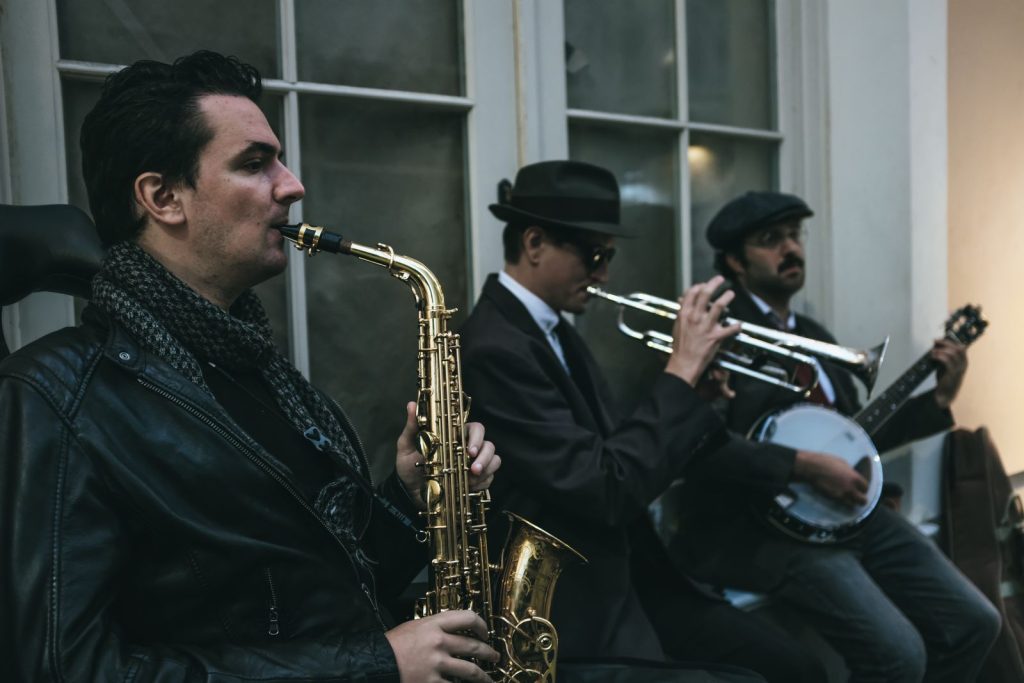
A swing band usually had a dozen or more players, grouped into brass, woodwinds and a rhythm section. In a typical lineup, the work was divided like this:
- Brass: trumpets and trombones, which supplied the punch and the shouting climaxes.
- Reeds: saxophones, often doubling on clarinet, which carried the smoother melodies and answered the brass.
- Rhythm: piano, guitar, bass and drums, the section that held the dancers on the beat.
The rhythm section had lightened over the years as the stringed bass and the guitar replaced the heavier wind basses and banjos of earlier jazz. The result was a lighter foundation than early jazz had used.
The arrangements were not improvised in a free-for-all. Skilled orchestrators wrote them, and sections of the band often played against one another, trading phrases back and forth. The riff, a short repeated phrase, was a favorite device. Fletcher Henderson and his brother Horace were among the most influential arrangers of the period.
The Leaders
Goodman was born in Chicago on May 30, 1909, and he became known as the King of Swing. The swing era itself is generally dated from about 1935 to the middle of the 1940s, and Britannica lists a whole roster of leaders who defined it:
- Duke Ellington: described by Britannica as the best band of the era.
- Count Basie: perhaps next. Basie was stranded in Kansas City in 1927 and stayed, and in 1935 he took over leadership of a nine-piece group.
- Benny Goodman: the clarinetist billed as the King of Swing.
- Harry James, Tommy Dorsey and Jimmy Dorsey: leaders whose bands drew national followings.
- Glenn Miller: the trombonist whose orchestra produced some of the biggest hits.
- Chick Webb and Jimmie Lunceford: leaders who built bands with their own distinctive sounds.
It is hard to name a single moment when a style begins, but the Palomar night has the neat advantage of a date, a place and a national audience.
The Ballroom in Harlem
For many dancers, the center of the swing world was the Savoy Ballroom at 596 Lenox Avenue in Harlem, which opened on March 12, 1926. It occupied a second floor a block long, and its policy was no discrimination. The crowd was mostly Black, with a substantial white presence on many nights. The Lindy Hop was developed and became famous there.
The house band for much of the 1930s was led by drummer Chick Webb. Britannica credits his band with setting the standard of excellence other big bands aspired to, and a teenage singer named Ella Fitzgerald helped boost its popularity. In 1937, the Goodman orchestra challenged Webb’s band to a battle at the Savoy, and Webb’s players were declared the winners.
Webb died in Baltimore on June 16, 1939. The Savoy outlasted him by almost two decades, closing in 1958 and coming down in 1959 to make way for a housing complex.
A Mixed Group on a Public Stage
Goodman’s small groups included Black musicians, which was unusual on public stages of the time. Teddy Wilson, a pianist, joined the trio in 1935, followed by the vibraphonist Lionel Hampton in 1936 and the electric guitarist Charlie Christian in 1939. Britannica calls Goodman’s small-group work a major contribution to jazz history.
On January 16, 1938, the Goodman band played a concert at Carnegie Hall, presenting jazz as a prestige event. Guests from the Duke Ellington and Count Basie bands joined in. The recording of that night is considered one of the greatest live jazz albums.
It almost went unheard. The concert was recorded at the request of Goodman’s friend Albert Marx as a gift for the singer Helen Ward, and another copy went to Goodman. His copies sat in a closet for about twelve years, until 1950, when he handed the masters to Columbia Records. The double album that followed made the concert a legend.
Eight Minutes and Forty-Three Seconds
“Sing, Sing, Sing” was written by Louis Prima, who first recorded it in 1936 with his New Orleans Gang. Goodman recorded his own version in Hollywood on July 6, 1937, with an arrangement by Jimmy Mundy. Drummer Gene Krupa played on it, and his drum work on the record became one of the most famous features of the era.
The recording ran 8 minutes and 43 seconds, long enough that it needed both sides of a twelve-inch 78 rpm record. At Carnegie Hall the following January, a live version stretched to 12 minutes and 30 seconds, with improvised solos that differed from the studio take. The 1937 record was inducted into the Grammy Hall of Fame in 1982.
A Million-Seller and the First Gold Record
Glenn Miller played trombone, joining Ben Pollack’s orchestra in the mid-1920s and working as a freelance trombonist and arranger from 1928 to 1936.
He formed his first band in 1937, and that one did not last. He disbanded it in early 1938 and immediately assembled a new orchestra, which brought him lasting fame. According to Britannica, his composition “Moonlight Serenade” in 1939 was his first million-selling recording, and “In the Mood” and “Chattanooga Choo Choo” were also among the band’s popular records.
“Chattanooga Choo Choo” was recorded in Hollywood in the spring of 1941 and released that year. It appeared in the film Sun Valley Serenade. On February 10, 1942, the record was certified for sales of 1.2 million copies, and the record is often described as the first gold record.
When the Music Stopped
Not every threat to the bands came from a battlefield. On August 1, 1942, the American Federation of Musicians, led by its president James C. Petrillo, began a strike that barred union musicians from making commercial recordings. The dispute was over royalty payments. Live radio, concerts and V-Discs for the armed forces were not affected.
The V-Disc exception has its own story. The government started that label in 1943 as a “V for Victory” effort, and the records were made for military personnel rather than for sale. On October 27, 1943, Captain Robert Vincent persuaded Petrillo to let union musicians record for the military, on the condition that the discs not be sold and the masters be disposed of.
Among the recordings was a version of Glenn Miller’s “Moonlight Serenade” made in November 1943. The label ended in 1949.
Smaller companies settled first. Decca reached agreement in September 1943 and Capitol on October 11, 1943, while RCA Victor and Columbia held out until November 11, 1944. Before the strike, big bands had dominated popular music. Afterward, vocalists took over, and companies often recorded singers with backup vocal groups instead of orchestras.
Britannica adds that the swing era ended as singers who had started out as swing stylists, such as Frank Sinatra, Nat King Cole, Peggy Lee and Sarah Vaughan, became more popular than the bands they sang with. The war itself took musicians through the draft and brought rationing, and these pressures contributed too. Britannica also links the harmonic experimentation of the late swing years to the arrival of bebop, a style made for listening rather than dancing.
The Flight Over the Channel
From late 1942 until his death, Miller led the Army Air Force Band, a large orchestra with a swing band at its core. In December 1944, he boarded a military flight from England to Paris.
Britannica gives December 16, 1944, as the date of his death at sea. No confirmed trace of the plane was ever found. For a bandleader whose records had sold in the millions, it was an unresolved end, and it came when the swing era was already fading.