Car Maintenance in the 1960s: A Driver’s Calendar
By Diane Porter · Published · 7 min read
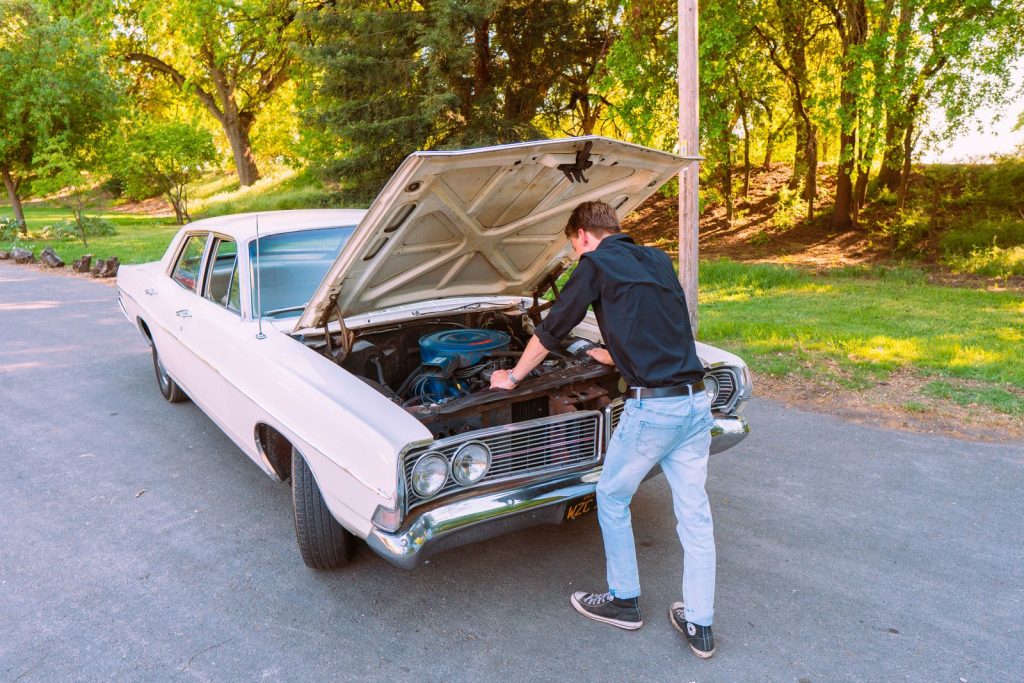
A driver who pulled into a full-service station in the 1960s and bought fifty cents of gas could still expect the attendant to check the water, the battery and the oil under the hood. The windshield got washed too, and a rack of free road maps stood nearby. The purchase size hardly mattered.
That small ritual was only the first layer of car care. Owning a car in those years meant living by a calendar of services that most modern drivers never see. What that calendar contained, and why it faded, says a lot about how cars and driving changed.
At Every Fill-Up: The Attendant
Full service was the norm before 1970, and self-service was rare. A typical attendant wore a uniform, carried cash for change and took credit cards inside, returning with a slip on a tray along with a pen. Later, portable imprinters let attendants process the payment right at the car. A black rubber hose stretched across the driveway rang a bell inside the station whenever a car rolled over it.
Many stations had service bays, which is why most were properly called service stations. Some posted a sign reading “Mechanic on Duty,” and some of the work done there was far more involved than pumping gas. Free road maps were expected to be on hand, and attendants sometimes marked the route on one for a driver who was lost.
Self-service existed earlier than many people assume. Frank Urich is credited with opening the first self-service station, in Los Angeles in 1947. New Jersey passed a safety act in 1949 that barred it, after lobbying by station owners.
Every Few Months: Oil and Grease
Oil changes came often. Recollections and quoted owner’s manuals from the era put the interval for many cars at about 2,000 to 3,000 miles in the 1950s, and a few manuals allowed 4,000 or 5,000 miles.
Then there was the grease job. Many suspension and steering parts had small fittings through which a grease gun forced lubricant. One automotive writer, summarizing a Hemmings article, says the schedule tended to be mileage-based, about every thousand miles for a good many parts. Those parts included steering joints, tie rods, ball joints and spring shackles.
The fitting itself dates to January 1929, when Oscar Zerk received a patent assigned to Alemite, replacing older cups and oilers that relied on gravity or hand pressure. Even a 1936 Cadillac lubrication chart already showed a dozen or more points that needed attention.
Cars gained more of these points as front suspensions became more complex. Ford and the Lincoln Industrial Corporation developed an automatic system offered on late-1950s Lincoln-Mercury cars, in which the driver pressed a button on the dash while driving and a green light signaled that greasing was done. A reservoir under the hood held enough grease for 250 to 300 applications, and the system faded because of cost and consumer concerns.
Every Year or So: The Tune-Up
A tune-up was a package of services done at a set interval. Owner’s manuals of the period called for one roughly every 10,000 miles. The package centered on the ignition system and the carburetor.
A typical package covered these items:
- Spark plugs: replaced, along with a look at the plug wires.
- Distributor cap and rotor: checked for wear and corrosion.
- Breaker points and condenser: replaced as a routine item.
- Ignition timing: checked with a timing light.
- Carburetor idle: adjusted so the engine ran smoothly at rest.
Adjusting the carburetor’s idle, often with a tachometer and a vacuum gauge, was standard practice until about 1980. Some older air cleaners used a small bath of oil, and that oil was cleaned and refilled around tune-up time.
The points are the part that most defined the era. A contact breaker is a switch opened by a cam on the engine, and each opening collapses a magnetic field in the coil to produce the spark. Because the points open and close constantly, they wear and pit from arcing, and a small capacitor called the condenser helps reduce that arcing. The points also need periodic adjustment and become imprecise at high engine speeds, although they have been favored on some aircraft engines because they are simple and degrade gradually rather than failing suddenly.
Changes Under the Hood
Even in the early 1960s, the engine was starting to carry anti-pollution equipment. In 1961, California required all new cars to be sold with a positive crankcase ventilation system, the first vehicle emissions control device. By the 1963 model year, most new American cars had one through voluntary industry action rather than a federal mandate.
The industry itself drew scrutiny. In 1967, a federal grand jury investigated whether the automakers’ trade association was delaying smog-reduction devices. After 18 months it returned no indictment, and a ten-year consent decree barred joint smog-control work among American automakers.
The idea had a military origin, since the first such systems were built during World War II so that tank engines could ford deep water without the crankcase taking in water. In cars, it replaced a simple road draft tube, which used airflow beneath the car to vent crankcase gases into the open air. That tube caused pollution and odors, and it could clog with snow or ice.
Fuel mattered as well. Engines built before 1971 used soft valve seats that the lead in gasoline helped protect. The federal Environmental Protection Agency began limiting lead in 1973, and by the middle of the decade attendants were asking whether a customer wanted leaded or unleaded.
What Rolled on the Road
Tires and brakes looked different, too. Bias-ply tires, with crisscrossed layers, were the American standard even though Michelin had developed the radial design in 1946. A 1968 article in Consumer Reports highlighted the benefits of radials, and the bias-ply tire persisted in the United States until Ford adopted radials in the early 1970s.
Radials reached the whole North American market in the 1980s. Their advantages included longer tread life, better steering control and a steadier ride at speed, while the drawbacks included a harder ride at low speeds.
Brakes were mostly drums on all four wheels, with disc brakes arriving on a handful of models:
- Crosley Hot Shot, 1949 to 1950: four-wheel discs that proved troublesome and were removed.
- Studebaker Avanti, 1963: front discs as standard equipment.
- Rambler Marlin, 1965: front discs as standard equipment.
- Chevrolet Corvette Stingray, 1965: four-wheel discs.
Discs cool more readily than drums, so they are less prone to fade from overheating. Most American cars changed from front drums to front discs in the late 1970s and early 1980s.
The Warranty That Wanted Receipts
Owners also had warranties to think about. The industry standard in the early 1960s was two years or 24,000 miles. Chrysler broke from it with a five-year, 50,000-mile warranty on principal engine and powertrain parts, and General Motors and Ford reportedly dismissed the idea at first before having to match it.
The coverage came with conditions. A paper presented in 1966 describes a program resting on an assurance of reasonable owner care. Owners had to have their cars inspected at intervals, and the records had to be kept for about five and a half years.
The terms did not stay fixed. One magazine account says Chrysler quietly changed the warranty in 1967 so that it covered only the first two owners of a new car.
Why the Calendar Emptied Out
Much of the calendar disappeared as the parts themselves changed. Electronic ignition systems eliminated contact wear and allowed computer-controlled timing, so the points became unnecessary. Sealed ball joints and tie-rod ends were designed to be lubricated for the life of the car, so the grease gun had less to do.
Radial tires lasted longer than bias-ply tires, and self-service pumps took the attendant out of the driveway. The routine of checking, greasing and adjusting did not vanish overnight. It thinned out over the 1970s, 1980s and beyond.
What remains is a memory of a different relationship with the car. Drivers then expected to be involved, even if only to nod when an attendant held up a dipstick and said it was a quart low.