How Television Took Over the 1950s Living Room
By Greg Lawson · Published · 7 min read
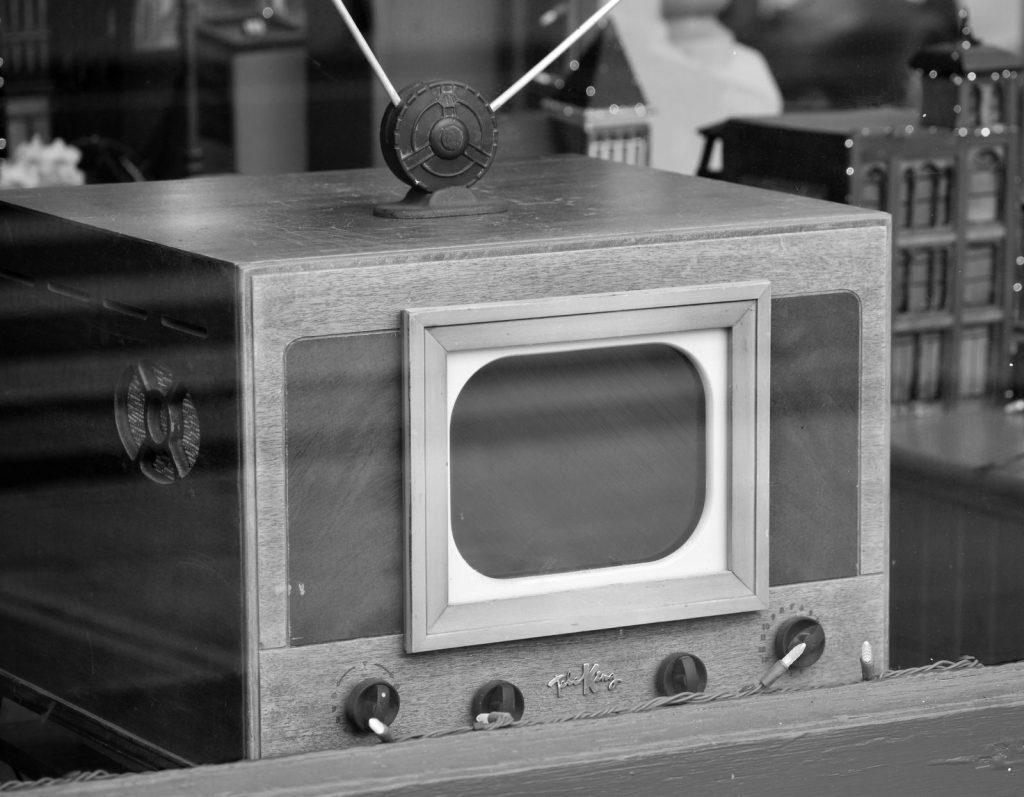
In 1948, about 1 percent of American households owned a television set. By 1955, 75 percent did. That speed changed where Americans sat, what they talked about and, for many families, when they ate dinner.
The living room of the 1950s was reorganized around a glowing screen, and the programs that came out of it gave the decade much of its shared memory. This is a tour of that room through the things that filled it: the set, the Tuesday night habit, the weekly guide, a sitcom that was filmed in an unusual way and a set of hearings that played out in the afternoon.
The box in the corner
The set itself arrived before there was much to watch on it. Three networks organized the business: NBC, CBS and ABC. The first two started as radio networks, and ABC had an older history too.
- NBC began operating in 1926
- CBS began operating in 1927
- ABC was spun off from NBC in 1943, when it was known as the Blue Network, and its television operation did not match the viewership and reach of the other two until the late 1960s
A fourth network, DuMont, operated from 1948 until 1956. The idea of a fourth competitor kept returning, but none of the attempts lasted long. For most families, television meant three choices.
Tuesday night with Uncle Miltie
Texaco Star Theater arrived on NBC on June 8, 1948, with Texaco as the sponsor. Milton Berle hosted the first television episode under a four-week contract, and by that fall he was the permanent host. The show gave him the nickname Mr. Television, and he began calling himself Uncle Miltie after ad-libbing the phrase at the end of a 1949 broadcast.
The ratings were enormous. In the 1950 to 1951 season, the show ranked first with a rating of 61.6, and it dominated Tuesday from 8 to 9 p.m. Eastern time. It is often credited with driving television set sales, though the figures that circulate for that are loosely sourced. One writer described the effect as bringing the country to a standstill every Tuesday night.
Buick took over sponsorship after Texaco’s run ended in 1953. The program became The Milton Berle Show in 1955, and it ended in June 1956. By the 1954 to 1955 season, its rating had dropped to 34.6 and it ranked eleventh, as more rivals filled the schedule.
The guide on the coffee table
Once there were enough stations, viewers needed a way to find out what was on. Local listing magazines appeared in 1948, including TeleVision Guide in the New York area, which first came out on June 14, and TV Forecast in Chicago, which first appeared on May 9. A third, TV Digest, served Philadelphia and Pittsburgh beginning in November.
In 1953, several of those regional magazines were combined into a national weekly, and the first issue of TV Guide appeared on April 3. It reportedly sold about 1,560,000 copies in ten cities. The cover showed Lucille Ball’s newborn son, Desi Arnaz Jr., with a small photo of his mother in an inset, under a headline about a fifty-million-dollar baby. The price was 15 cents.
Sales fell by about 200,000 copies in the months that followed, then recovered with the “Fall Preview” issue of September 1953, which reached 1,746,327 copies. By the 1960s it was the most widely read magazine in the country, and circulation peaked at almost 20 million in 1970.
The sitcom shot like a movie
I Love Lucy aired on CBS from October 15, 1951, to May 6, 1957, in 180 half-hour episodes. The show was sponsored by Philip Morris. Ball and Arnaz had planned a biweekly schedule, but the sponsor insisted on weekly episodes, and it also wanted the show produced in New York, where most television was still broadcast live. West Coast viewers saw such shows only as lower-quality kinescope recordings.
Lucille Ball and Desi Arnaz insisted on staying in Hollywood and filming on motion-picture film. They cited the coming birth of their first child. CBS and the sponsor balked at the extra cost and agreed only after the couple offered a $1,000-a-week pay cut, and in exchange they received 80 percent ownership of the films.
The show used three 35-millimeter cameras and a live studio audience of about 300. It is described as the first scripted television program filmed on 35 mm film in front of a studio audience. The film copies also meant that episodes could be rerun, and reruns began when Ball’s pregnancy limited the number of new episodes in the second season.
The show’s rise was swift. It ranked third in its first season, and then it ranked first in the second season with an average rating of 67.3, which is described as the highest average for any single television season. It was the most-watched program in four of its six seasons.
On January 19, 1953, the episode in which Lucy goes to the hospital drew a rating of 71.7, which one account equates to about 44 million viewers. It aired the day before Eisenhower’s inauguration. CBS would not allow the word “pregnant,” so the scripts used “expecting.”
The reruns found a second audience. CBS added them to its early-evening weekend schedule in April 1955, and off-network syndication began in the fall of 1967.
The hearings in the afternoon
Television could also bring public events into the living room. The Army-McCarthy hearings began on March 16, 1954, with live, gavel-to-gavel coverage from April 22 to June 17, which amounted to 36 days. ABC and the DuMont network carried the hearings in full.
An estimated 80 million people saw at least part of the proceedings, according to one account, and some segments reached as many as 20 million viewers at once. On June 9, Army counsel Joseph Welch confronted Senator Joseph McCarthy over an attack on a former colleague. McCarthy had called the television audience the jury in the case.
Gallup polling showed McCarthy’s approval falling from 50 percent in January 1954 to 34 percent in June. The Senate voted 67 to 22 to censure him on December 2, 1954. Historians still debate how much the broadcasts caused the change, but the hearings showed how television could turn a political fight into a national experience.
When the big-money contests were rigged
Game shows were among the most popular programs of the decade, and the biggest ones paid out large sums. The $64,000 Question on CBS was a top-rated show. Twenty-One on NBC, which premiered in September 1956 with Jack Barry as host, lagged in popularity at first, and the producers took steps to improve the drama.
Producer Dan Enright coached Herb Stempel, a long-running champion, to lose to a Columbia University English teacher named Charles Van Doren on December 5, 1956. Stempel told a journalist about the arrangement in 1957, but no article ran because he had no proof. Another contestant, James Snodgrass, had mailed himself dated letters listing the coached answers, and those letters later served as evidence.
A New York grand jury looked into the matter in 1958 and 1959 without producing indictments. In October 1959, a House subcommittee led by Oren Harris held hearings, and on November 2 Van Doren told the members that he had been deeply involved in a deception. The next year, on September 13, 1960, President Eisenhower signed an amendment to the Communications Act that made fixing televised contests of knowledge or skill illegal.
The networks took more control of programming afterward. ABC capped game-show winnings at $20,000 and CBS at $25,000, and big-money contests largely disappeared from the screen for several years.
The network that did not make it
DuMont, the fourth network, shut down its operations in 1956. Another attempt, the NTA Film Network, ran from 1956 to 1961 and is arguably a fourth network only for those years. The three-network structure that formed in the 1950s lasted for decades.
In the end, that structure explains why so many Americans remember the same shows. With only three channels to choose from in most places, a family in Ohio and a family in Oregon were often watching the same thing at the same hour. The shared screen was one of television’s biggest effects on the country, and it began in the 1950s living room.