Military Slang That Became Everyday English
By Ellen Brooks · Published · 7 min read
The word “snafu” arrived in print with a cover story attached. In public explanations, the last word of the phrase it abbreviates was usually given as “fouled,” as in “situation normal, all fouled up.” The soldiers who coined it had chosen a stronger word, and the polite version was for everyone else.
The Oxford English Dictionary, as quoted by the Online Etymology Dictionary, describes the term as expressing the common soldier’s laconic acceptance of the disorder of war. It is a good example of how military slang works. A short, funny word carries a feeling, and the feeling travels long after the war is over.
A Phrase With a Polite Cover Story
“Snafu” is dated to 1943 as a noun and 1942 as an adjective, although the expression itself was attested by 1941. It is an acronym, and it entered English as World War II American military slang for a confusion or mix-up, especially a large and complicated one.
Not every word on this list has a trail that solid. Several of the stories below come with a note of doubt, and each is marked that way.
Words From Overseas Duty
“Boondocks” is a good example of a word picked up abroad. It comes from the Tagalog word bundok, meaning mountain. American soldiers occupying the Philippines adopted it, and in English it became a name for a remote and wild place. The Online Etymology Dictionary dates the English word to the 1910s, and notes that it was reinforced during World War II.
A related word followed. “Boondockers,” meaning shoes suited to rough terrain, is first recorded in 1944 as U.S. services slang for field boots. A word for a mountain in the Philippines thus ended up on the feet of American servicemen.
Words From the Air
Aircraft contributed some of the most familiar words. “Flak” is short for the German Fliegerabwehrkanone, which translates roughly as pilot-warding-off cannon. It is recorded in English in 1938 as a word for an anti-aircraft gun. The figurative sense of criticism, as in “taking flak,” appears around 1963 in American English.
“Blockbuster” began as the name of a very large bomb. The Online Etymology Dictionary records it in 1942 for a bomb of about 4,000 pounds or more, and says the word combines “block,” in the sense of a built-up city square, with an agent noun from “bust.” By 1952 it was being applied to a spectacularly successful production, such as a film.
“Ace” took a longer road. The word comes from the playing card, which is ultimately from a Latin word for “one.” The sense of an outstanding pilot is dated to 1917, borrowed from a French term used before the war for top athletes, such as boxers and cyclists. In World War I pilot jargon it originally meant a pilot with five victories, and one account says it technically meant ten.
Radio and a Cannonball
“Roger” belongs to the age of radio. In radio communication it means “yes, I understand,” and the Online Etymology Dictionary dates that use to 1941. It comes from the military phonetic alphabet word for the letter R, standing for “received.” The same entry says the Royal Air Force reportedly used it the same way from 1938.
“Shrapnel” is a case where the modern meaning is not the original. The word comes from Henry Shrapnel, a British artillery officer who developed a hollow cannonball filled with shot and a small bursting charge, designed to explode in the air in front of the enemy. The word is recorded in 1806 for that shell. Its use for fragments of any exploding shell dates only to 1940, which the Online Etymology Dictionary calls a mistaken modern usage.
Words From the Trenches
World War I left its mark on the vocabulary too. “Camouflage” is recorded in English in 1917, as a noun, a verb and an adjective. It comes from the French camoufler, which the Online Etymology Dictionary describes as Parisian slang for “to disguise.”
The French word came from Italian camuffare, whose own origin is uncertain. One possibility is a contraction of a phrase meaning “to muffle the head.” The French form may also have been reshaped by a word for a puff of smoke blown into a sleeper’s face.
An August 1917 article in Popular Science Monthly described camouflaged artillery, painted trains and devices hiding guns and roads from enemy aircraft, and it defined the new word as fooling the enemy. The British navy called its version of the practice dazzle-painting.
“Scrounge” is recorded in 1915 in the sense of acquiring something by irregular means. A dialect word, “scrunge,” is recorded in 1909 for searching stealthily or pilfering, and its origin is uncertain. The word was popularized in the military during World War I, often as a polite way of saying “steal.”
Three Stories to Hold Loosely
Some of the best-loved origin stories come with a catch. Three are worth knowing for what they claim and what they leave out.
- Gung ho. Merriam-Webster says it was a motto adopted by some U.S. Marines in 1942. Lt. Col. Evans Carlson, organizing the Second Raider Battalion in California, told his men it was Chinese for “work together.” The dictionary notes that the Chinese syllables for “work” and “join” seem to fit, but cannot actually be combined to mean that. The motto came from the shortened name of a Chinese industrial cooperative society, and in English it stuck as an adjective for extreme enthusiasm.
- G.I. The abbreviation was listed on garbage cans and similar items as short for galvanized iron. Merriam-Webster says it was taken as an abbreviation for government issue. The adjective is recorded from 1926, and the noun for a soldier from 1943. The word kept spreading, with an adverb recorded from 1949 and a verb from 1951.
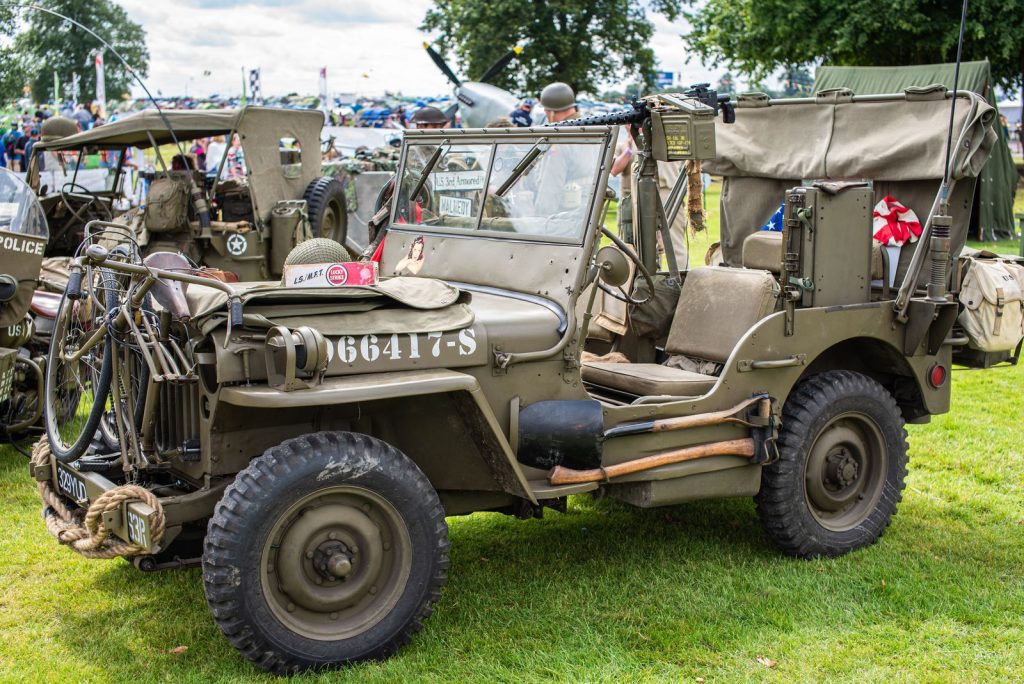
- Jeep. The Online Etymology Dictionary presents the word as an acronym for general purpose, and records it in early 1941. It adds that the word was certainly influenced by Eugene the Jeep, a character in the Popeye comic strip who had extraordinary powers and said only one word. The entry finds no use of the word before 1941, and notes that the vehicle was in development from 1940, when Army planners called it a light reconnaissance and command car.
In each case, the clean explanation may be only part of the picture, and the real origin probably combined more than one influence.
Words From the Barracks
“Goldbrick” began in the world of cons. Merriam-Webster dates the noun for a worthless brick that appears to be gold to 1865, and the verb for swindle to 1893. The dictionary notes an 1881 National Police Gazette article describing the swindle, in which con artists passed base-metal bricks off as gold.
The military sense of a shirker came out of U.S. Army slang, where it described a soldier who faked illness or injury to avoid work. It was in use by the time World War I began. The word then moved into civilian life, where it still describes someone avoiding a task.
“Boot camp” is recorded by 1941 as Marines slang for a training station for recruits. It comes from “boot,” slang for a recruit, which is attested by 1915 and is said to date from the Spanish-American War. The recruit sense derives from “boots,” the leggings worn by U.S. sailors.
Footwear runs through all of these words. The sailors’ leggings gave the recruit his nickname, “boondockers” named field boots, and the camp took its name from the recruit. Outside the service, boot camp now describes any short, intense training program.
The Evidence at a Glance
A short list shows how the dates fall, and how confident historians are:
- Snafu: attested by 1941, acronym, well documented.
- Flak: 1938 as a gun, from German, well documented.
- Boondocks: 1910s, from Tagalog, well documented.
- Blockbuster: 1942 as a bomb, well documented.
- Roger: 1941 in radio use, from the phonetic alphabet.
- Gung ho, G.I. and jeep: documented as words, uncertain as stories.
Where a word has a paper trail, such as a dated radio practice or a named inventor, the history is firm. Where it rests on a single story told afterward, as with the Chinese motto, the story deserves a note of doubt.